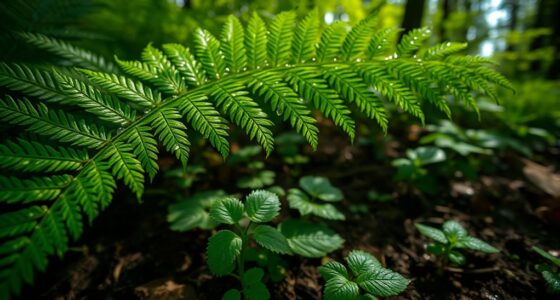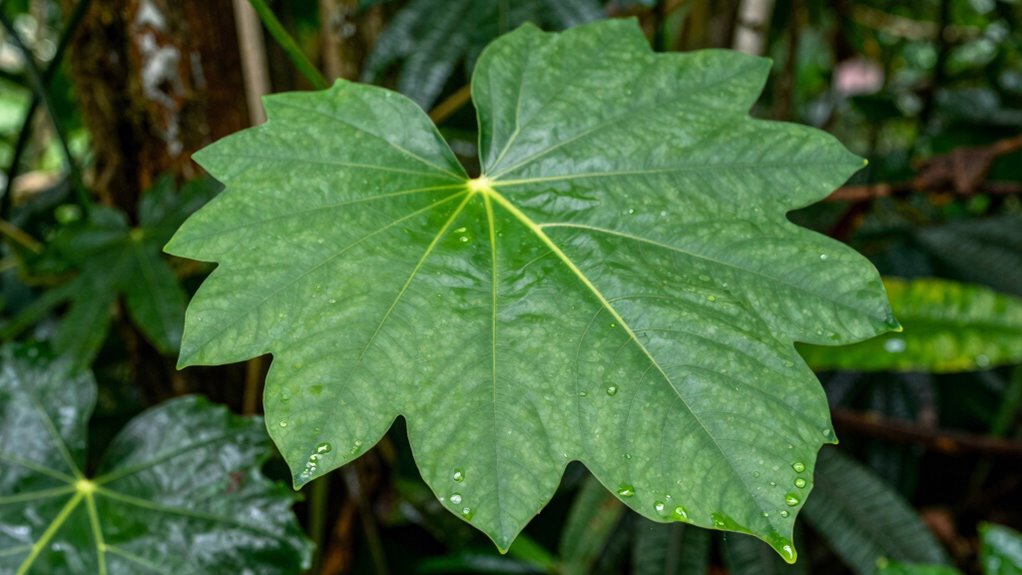
Your plant’s leaf shape reveals a lot about its native habitat. Broad, flat leaves often grow in shaded, moist areas like rainforests, helping maximize photosynthesis. Small, thick leaves indicate dry or cold environments, conserving water and warmth. Sharp or curled edges can protect against wind or dry air, while spiny leaves deter herbivores. By understanding these traits, you can uncover the environmental pressures the plant adapts to—keep exploring to discover more about what your plant’s leaves say about its home.
Key Takeaways
- Broad, flat leaves indicate shaded, moist environments like rainforests, optimizing photosynthesis in low light.
- Small, thick, leathery leaves suggest dry or cold habitats such as deserts or alpine regions.
- Leaf margin traits, like serration or smoothness, provide clues about environmental stresses like water runoff or wind resistance.
- Needle-like or curled leaves help reduce water loss and withstand windy, coastal, or arid conditions.
- Spiny or thorny leaves often reflect adaptations to deter herbivores in specific ecological niches.
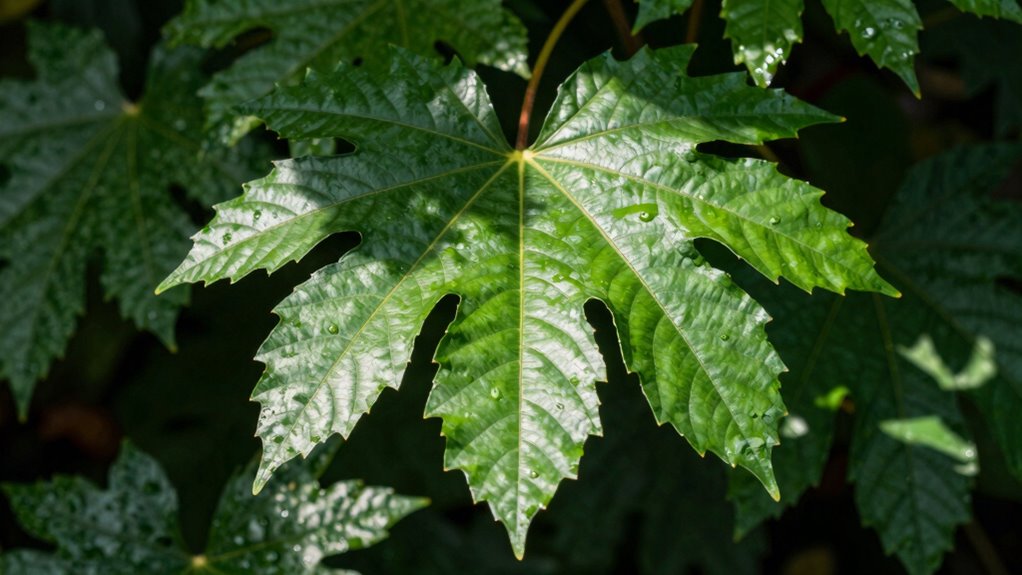
The shape of a plant’s leaves often reveals how it has adapted to its native habitat. When you observe a leaf’s form closely, you can gain insight into the environment where the plant naturally thrives. Leaf adaptations are responses to specific conditions, and they serve as environmental indicators, showing you what kind of climate or terrain the plant has evolved to survive in. Understanding these adaptations can help identify the specific environmental pressures a plant faces in its native habitat. For example, broad, flat leaves are typical of plants in shaded, moist environments because they maximize photosynthesis under low light. Conversely, narrow or needle-like leaves are common in arid or windy regions, where reducing water loss and withstand harsh conditions are priorities.
If you notice a plant with large, wide leaves, it’s likely adapted to a rainforest or a shaded woodland. These leaves often have a large surface area to capture as much sunlight as possible in low-light conditions. The presence of drip tips or waxy coatings on such leaves can also indicate their adaptation to high humidity and frequent rainfall, helping water run off quickly to prevent fungal growth. On the other hand, plants with small, thick, or leathery leaves are often found in desert or alpine habitats. These adaptations help conserve water in dry or cold environments, where moisture is scarce or freezing temperatures threaten tissue integrity. These specific leaf traits are essential clues to understanding a plant’s ecological niche and the environmental stresses it has adapted to. Additionally, leaf margin characteristics can also provide insight into the plant’s environmental adaptations, such as serrated edges for water runoff or smooth margins for wind resistance.
In coastal or windy areas, you might see leaves that are slender, needle-like, or have a curled shape. These leaf forms reduce wind resistance and minimize water loss, acting as vital environmental indicators of an environment that’s exposed to strong gusts or salt spray. The curling or folding of leaves in some plants also protects stomata—the pores responsible for gas exchange—further conserving moisture and shielding against harsh weather. Additionally, plants with spiny or thorny leaves often inhabit areas where herbivory is intense, showing an adaptation to deter animals from feeding on them. Recognizing these leaf traits can help you understand the ecological challenges a plant has adapted to in its native environment.

Trees: An Illustrated Field Guide
As an affiliate, we earn on qualifying purchases.
As an affiliate, we earn on qualifying purchases.
Frequently Asked Questions
How Do Leaf Shapes Affect a Plant’s Water Retention?
Think of leaf shapes as water-saving tools in nature’s toolbox. Narrow, elongated leaves have a smaller leaf surface, reducing water loss through evaporation, while thicker leaves often boast fewer stomata, limiting water escape. Conversely, broad leaves with many stomata maximize water release to cool the plant. By adjusting leaf shape, plants fine-tune water retention, thriving in their native habitats—whether arid or lush.
Can Leaf Shape Determine a Plant’s Drought Tolerance?
Yes, leaf shape can determine a plant’s drought tolerance. Through leaf shape evolution, plants develop features like narrow, deep lobes or thick, leathery textures that help conserve water. Genetic influences drive these adaptations, enabling plants to survive in dry conditions. By analyzing leaf shape, you can often predict a plant’s ability to withstand drought, as certain shapes are better suited for water retention and minimizing water loss.
Do Leaf Shapes Influence a Plant’s Ability to Resist Pests?
Your plant’s leaf morphology can give it a subtle edge against pests. Sharp, pointed leaves might seem like a gentle warning, while broad, textured ones act as a natural shield. These shapes influence pest resistance, making it harder for pests to settle or feed comfortably. By understanding how leaf structure plays a role, you can select plants better equipped to fend off unwanted guests, enhancing your garden’s resilience naturally.
Are Certain Leaf Shapes More Common in Specific Climate Zones?
Yes, certain leaf shapes are more common in specific climate zones due to leaf shape evolution driven by environmental adaptation. In hot, dry climates, you’ll see thick, leathery leaves with small or spiny shapes to reduce water loss. Conversely, in humid, shaded areas, broad, flat leaves maximize photosynthesis. These adaptations help plants survive and thrive, reflecting how leaf shape evolution responds to climate conditions across different zones.
How Quickly Can Leaf Shape Adapt to Changing Environmental Conditions?
You might think leaf shape changes overnight, but in reality, genetic adaptation takes generations, not days. Evolutionary pathways are slow, so your plant’s leaves won’t quickly adapt to sudden environmental shifts. Ironically, while climate changes rapidly, your plant relies on long-term genetic shifts rather than quick tweaks. So, if conditions change suddenly, your plant’s leaf shape stays the same, revealing its evolutionary history far more than its current environment.
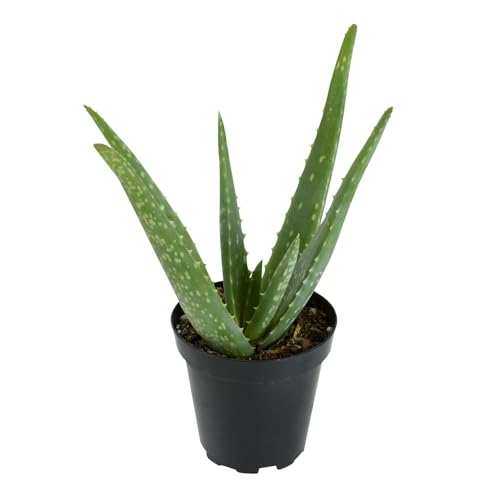
Live Aloe Vera Succulent Plant, Easy Indoor Houseplant, 3.5 in. Grower Pot, Drought Tolerant Succulents, Houseplants for Beginners (10-12" Tall), Natural Skin Care, Office Plant by Plants for Pets
A beautiful, structural succulent with healing properties
As an affiliate, we earn on qualifying purchases.
As an affiliate, we earn on qualifying purchases.
Conclusion
Just like a secret code, your plant’s leaf shape whispers clues about its homeland. Whether it’s the broad, sun-catching leaves or the narrow, wind-swept blades, each design tells a story of survival and adaptation. By understanding these leaf shapes, you reveal nature’s hidden map, guiding you to appreciate the lush, diverse world they come from. So, next time you look at a leaf, listen closely—its shape is nature’s storyteller, waiting to reveal its tale.
wind-resistant outdoor plants
As an affiliate, we earn on qualifying purchases.
As an affiliate, we earn on qualifying purchases.

200+ Seeds Culantro Seeds, Eryngium foetidum, Thorny Coriander, Spiny Coriander, NGÒ GAI
Culantro Seeds, Eryngium foetidum, Herb Seeds, Thorny coriander, Spiny Coriander, Fitweed, Saw-leaf or saw-tooth herb, recao and Tabasco…
As an affiliate, we earn on qualifying purchases.
As an affiliate, we earn on qualifying purchases.