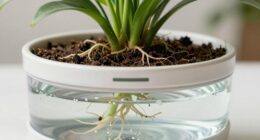
To understand how plants sense gravity, look at amyloplasts—tiny organelles inside specialized cells in roots and shoots. When you tilt the plant, these amyloplasts settle at the bottom due to gravity, triggering signals that guide growth. In roots, this causes the plant to grow downward, while in shoots, it makes them bend upward. Discovering how these small structures help plants navigate their environment shows the clever ways nature uses physical cues—more fascinating details await if you continue exploring.
Key Takeaways
- Amyloplasts are small organelles in plant cells that act as gravity sensors by settling under the influence of gravity.
- When tilted, amyloplasts sediment to the lower side, triggering biochemical signals that direct growth responses.
- In roots, sedimentation causes auxins to promote cell elongation on the lower side, bending the root downward.
- In shoots, amyloplasts settling on the lower side results in auxin distribution that causes upward bending.
- This automatic process allows plants to sense gravity and adjust their growth for proper orientation and stability.

Have you ever wondered how we can sense gravity without even thinking about it? It’s a fascinating process that starts deep within plant cells, specifically in tiny structures called amyloplasts. These specialized organelles act like biological gravity sensors. When a plant is upright, amyloplasts settle at the bottom of specialized cells in roots and shoots, serving as a kind of internal compass. This settling isn’t random; it’s a critical signal that helps the plant determine which way is down. The plant’s survival hinges on this sense—roots need to grow downward into the soil, while shoots grow upward toward the light. It’s a remarkable natural navigation system.
In the roots, amyloplasts sink to the lower side when the plant is tilted or reoriented. This sedimentation triggers a cascade of cellular signals that eventually influence growth patterns. The plant responds by directing growth hormones called auxins to the lower side of the root. These auxins promote cell elongation, causing the root to bend downward. Conversely, in shoots, the process is reversed: amyloplasts settle on the lower side, but auxins cause the cells there to slow growth, making the shoot bend upward. This mechanism ensures that roots anchor the plant securely while shoots reach for sunlight, optimizing the plant’s chances for survival and reproduction.
It’s important to realize that this sensing mechanism is incredibly sensitive. Even a slight tilt causes amyloplasts to settle, sending signals that initiate growth adjustments. The process doesn’t require conscious thought; it’s an automatic response embedded in the plant’s biology. This ability to perceive gravity is a proof to how life has evolved to adapt seamlessly to its environment. The sedimentation of amyloplasts acts like a natural mass-sensing device, translating physical orientation into biochemical signals. These signals then regulate growth, ensuring the plant remains properly oriented regardless of changes in its position. The gravity sensing mechanism is a prime example of how biological structures can serve as natural sensors.
Understanding how plants sense gravity through amyloplasts not only reveals the elegance of biological systems but also provides insights into how plants navigate their world. It’s a simple yet effective trick that allows them to grow upright and thrive. This mechanism reminds us that even the smallest structures in nature can perform complex, essential functions, guiding plants in a way that seems almost instinctual. So, next time you see a plant leaning or standing tall, remember the tiny amyloplasts working behind the scenes to keep it rooted and reaching upward.
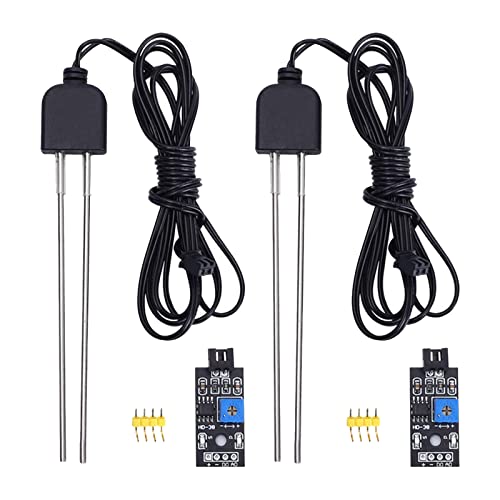
2 Sets Resistive Soil Moisture Meter, Icstation Soil Hygrometer Sensor Test Kit with Corrosion Resistant Probe, Digital Analog Signal Output for Arduino Garden Plant Care Automatic Watering System
- Soil Moisture Measurement: Analog resistance-based soil moisture detection
- Easy to Read Output: Low signal alerts for high moisture levels
- Compatible with Arduino & Raspberry Pi: Easy integration with popular microcontrollers
As an affiliate, we earn on qualifying purchases.
As an affiliate, we earn on qualifying purchases.
Frequently Asked Questions
How Do Amyloplasts Differentiate Between Gravity and Other Stimuli?
You can tell that amyloplasts differentiate gravity from other stimuli because they settle under the influence of gravity, thanks to their density. When the plant’s orientation changes, these dense plastids sink or float, triggering a response in the plant’s cells. This specific movement, driven by gravity’s force, helps your plant detect direction, unlike other stimuli like light or touch, which don’t cause the same sedimentation.
Are Amyloplasts Present in All Plant Species?
Imagine a world where not all plants have amyloplasts, and you’re right to wonder if they’re universal. While most land plants, like trees, and many flowering plants possess amyloplasts in their roots and shoots, some species, especially aquatic or primitive plants, may lack them or use alternative gravity-sensing methods. So, no, amyloplasts aren’t present in every plant, but they’re quite common among terrestrial species.
Can Artificial Gravity Influence Amyloplast Function?
Artificial gravity can influence amyloplast function by mimicking natural gravitational forces, causing the amyloplasts to sediment and signal gravity perception. When you experience increased or decreased gravity, it can alter how amyloplasts settle within the cells, affecting the plant’s growth responses. This manipulation helps scientists understand gravity sensing mechanisms and could potentially be used to guide plant growth in space or other altered environments.
What Is the Lifespan of an Amyloplast Within Plant Cells?
Amyloplasts typically last several days to weeks within plant cells, depending on the plant’s age and environmental conditions. You might notice that they are constantly forming and breaking down as part of the plant’s normal growth cycle. During this time, they actively sediment in response to gravity, helping the plant sense direction. Proper nutrient supply and cell health influence their lifespan, ensuring the plant adapts effectively to its surroundings.
Do Amyloplasts Interact With Other Cellular Signaling Pathways?
Yes, amyloplasts do interact with other cellular signaling pathways. When they settle under gravity, they trigger calcium and hormone signaling cascades that influence plant growth and development. You’ll find that these interactions help the plant adapt to its environment, coordinating responses like root growth direction and shoot orientation. By working with various signaling pathways, amyloplasts play a pivotal role in integrating gravity sensing with overall plant physiology.

UNGLINGA 272 Experiments Science Kit for Kids, Chemistry Set
- STEM Play Activities: Build volcanoes, grow crystals, and more
- 272 Experiments Included: Hours of educational fun for kids
- Child-Safe Science Tools: Realistic, durable plastic lab equipment
As an affiliate, we earn on qualifying purchases.
As an affiliate, we earn on qualifying purchases.
Conclusion
You might think amyloplasts are just simple starch-filled sensors, but recent research suggests they could play a more dynamic role in gravity detection. Some scientists believe they actively signal the plant’s response, while others argue they’re just passive indicators. The truth remains uncertain, making this a fascinating area of study. As you explore plant biology, remember that even tiny structures like amyloplasts could hold big secrets about how plants navigate their world.

Melphoe 25Pcs Mini Garden Hand Transplanting Succulent Tools Set, 39.4" Thickened Repotting Mat & Plant Tag, Miniature Planting Indoor Fairy Care, Potting, Cactus, Houseplant Bonsai Tool Kit (Black)
- Complete Mini Garden Tool Set: Suitable for succulents, bonsai, cactus, indoor plants
- Thick Waterproof Repotting Mat: 39.4 inches, stain-resistant, foldable, easy to clean
- Soil Splash Prevention Design: Copper buckles at corners prevent soil and water splashes
As an affiliate, we earn on qualifying purchases.
As an affiliate, we earn on qualifying purchases.

Life Size Artificial Flower Anatomy Model with Removable Parts for Botany Classroom Instruction and Group Activities Biology Teaching Supplies
- Scientific accuracy with reinforced joints: Scaled peach blossom model for repeated assembly
- Suitable for educators and students: Supports STEM curriculum in classroom and lab
- Realistic colors and detachable parts: Enhances hands-on plant anatomy demonstrations
As an affiliate, we earn on qualifying purchases.
As an affiliate, we earn on qualifying purchases.