
Xylem and phloem are the plant’s internal highways that transport crucial nutrients. Xylem moves water and minerals upward from roots to leaves, forming hollow, thick-walled vessels. Phloem carries sugars, organic compounds, and nutrients in multiple directions, supported by living sieve tube cells. Understanding how these systems work together guarantees your plant stays healthy and grows strong. Keep exploring to discover how each tissue uniquely supports plant life.
Key Takeaways
- Xylem transports water and minerals from roots to leaves, forming hollow, thick-walled tubes.
- Phloem distributes sugars and organic compounds from leaves to other plant parts via living sieve tubes.
- Xylem mainly moves substances upward, while phloem transports nutrients in multiple directions.
- Structural differences: xylem has thick, hollow vessels; phloem contains living sieve tubes supported by companion cells.
- Both tissues are essential for plant health, supporting hydration, nutrient distribution, and overall growth.
Understanding the differences between xylem and phloem is essential to grasp how plants transport nutrients and water. These two types of vascular tissue work together to keep your plants healthy, but they have distinct roles that are crucial for survival. Xylem primarily handles water transport, moving water from the roots up through the stems and leaves. It acts as a continuous pipeline, pulling water upward through capillary action and transpiration. This process not only supplies water to the plant’s tissues but also helps in nutrient distribution, as water dissolves minerals from the soil and carries them to various parts of the plant. Without efficient water transport via the xylem, plants would struggle to stay hydrated and to distribute essential nutrients to their cells.
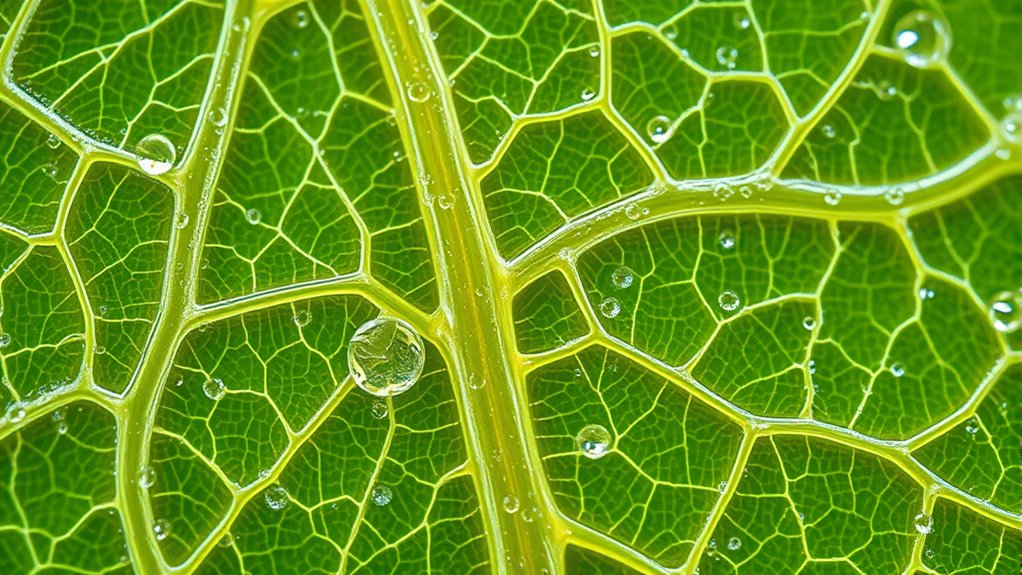
Xylem transports water from roots to leaves, supporting hydration and nutrient distribution in plants.
On the other hand, phloem is responsible for nutrient distribution, especially the movement of sugars and organic compounds produced during photosynthesis. Unlike xylem, which moves water upward, phloem can transport nutrients in multiple directions, depending on the plant’s needs. When you see a plant growing new leaves or flowers, it’s the phloem that delivers the energy-rich sugars from the leaves (where they are produced) to other parts of the plant. This process, called translocation, ensures that all parts of the plant receive the necessary nutrients to grow, repair, and carry out metabolic functions. Phloem’s ability to distribute nutrients efficiently is vital for the plant’s overall health and growth.
In terms of structure, xylem vessels are often thick-walled and hollow, designed to withstand the pressure of water movement. They form long, continuous tubes that run from the roots to the leaves, making water transport highly efficient. Phloem, however, consists of living cells that form sieve tubes, which are specialized to transport organic nutrients. These sieve tubes are supported by companion cells that regulate their activity, ensuring the smooth flow of nutrients throughout the plant.
Understanding how these two systems operate gives you a clearer picture of a plant’s internal logistics. Water transport via xylem ensures hydration and mineral uptake, while nutrient distribution through phloem supplies energy and building blocks needed for growth and repair. Both are vital, working in harmony to sustain the plant’s life cycle. The efficiency of these systems is supported by the vascular tissue systems, which are essential for plant health and productivity. Without xylem and phloem functioning properly, plants wouldn’t be able to thrive, highlighting the importance of these internal highways in supporting plant health and productivity.
Frequently Asked Questions
How Do Xylem and Phloem Develop During Plant Growth?
During plant growth stages, you see vascular tissue development as xylem and phloem form from the procambium during primary growth. Xylem develops to transport water, while phloem forms to carry nutrients and sugars. As the plant matures, secondary growth adds more xylem and phloem, strengthening the plant. You can observe this development as the vascular tissues differentiate and organize to support the plant’s increasing size and metabolic needs.
Can Xylem and Phloem Be Differentiated Under a Microscope Easily?
Under a microscope, you can distinguish xylem and phloem like night and day, thanks to cell wall differences and staining techniques. Xylem cells have thick, lignified walls, appearing darker with specific stains, while phloem cells have thinner walls and stain lighter. These visual cues help you identify them easily, turning a microscopic jungle into a familiar map of plant highways, guiding water and nutrients throughout the plant.
What Roles Do Xylem and Phloem Play in Plant Defense?
You can see that xylem and phloem contribute to plant defense by acting as plant pathogen barriers, preventing harmful microbes from spreading. Furthermore, they facilitate chemical defense mechanisms, like transporting defensive compounds to infection sites. Xylem’s structure helps block pathogen entry through water transport, while phloem moves signaling molecules that activate defenses, making these tissues essential for your plant’s resilience against diseases.
Are Xylem and Phloem Present in All Plant Species?
You’ll find xylem and phloem in most plant species, but their presence varies due to plant vascular diversity. Some species have specialized structures or reduced vascular tissues, especially in non-vascular plants like mosses. In vascular plants, these tissues are essential for transport, though their arrangement and complexity can differ. So, while common, their presence and structure are often species-specific, reflecting adaptations within different plant lineages.
How Do Environmental Conditions Affect Xylem and Phloem Functions?
Environmental conditions greatly impact xylem and phloem functions. During drought stress, your xylem struggles to transport water efficiently, risking dehydration. Meanwhile, nutrient uptake via the phloem slows down when soil nutrients are scarce, affecting overall plant health. Extreme temperatures or low humidity can also impair these systems, making it harder for your plant to maintain growth and essential processes. Proper care helps support their ideal function in changing environments.
Conclusion
Now that you understand how xylem and phloem work together, you see they’re like two sides of the same coin—each essential for plant health. You might recall the saying, “A chain is only as strong as its weakest link,” reminding you that both systems must function harmoniously. By appreciating their roles, you gain a deeper respect for how plants thrive, proving that in nature, teamwork truly makes the dream work.