Plants that live on trees without soil develop special roots to cling securely to bark or branches, often thick or velvety to maximize gripping surfaces. They absorb moisture and nutrients directly from the air, rain, and debris, using sponge-like tissue called velamen. Many form partnerships with fungi to improve nutrient uptake. These adaptations help them survive in nutrient-poor environments and show just how ingenious nature can be. Keep exploring to discover more fascinating plant strategies for thriving without soil.
Key Takeaways
- They develop specialized roots that cling to bark and maximize surface area for support and attachment.
- Roots absorb moisture and nutrients directly from air, rain, and debris using velamen tissue.
- They decompose organic material like leaves and dust to access essential nutrients.
- Symbiotic relationships with fungi (mycorrhizae) enhance nutrient absorption from the environment.
- Adaptations enable survival on nutrient-poor surfaces by securing support and efficiently capturing atmospheric nutrients.
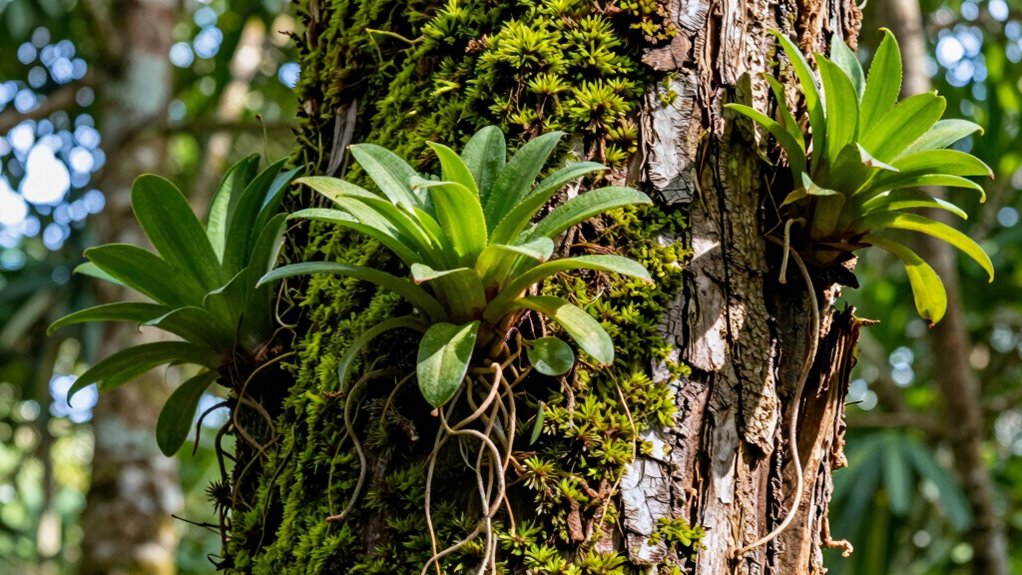
Many plants have found a way to thrive on trees without the need for soil, showcasing remarkable adaptations. Instead of growing in the ground, these plants develop unique root structures that allow them to cling to bark or branch surfaces. You might notice how some epiphytes, like orchids and bromeliads, have roots that are specialized for anchoring rather than for absorbing nutrients from soil. These roots often appear thick, fuzzy, or velvety, and are designed to maximize surface area. This adaptation helps them grip onto the rough or smooth surfaces of tree trunks and branches securely, preventing them from falling.
Many epiphytes develop specialized, velvety roots for secure attachment and nutrient absorption from air, rain, and debris.
When it comes to nutrient absorption, these plants have evolved strategies that differ from traditional soil-dependent plants. Since they don’t have access to soil nutrients, they rely on alternative methods to gather what they need to survive. For instance, many epiphytes have specialized roots that can absorb moisture and nutrients directly from the air, rain, and debris that collects around them. The roots are often covered with a spongy tissue called velamen, which acts like a sponge, trapping water and nutrients from their surroundings. This allows them to thrive even in nutrient-poor environments, relying heavily on their ability to efficiently absorb what little sustenance is available. Adaptations for nutrient uptake are crucial for their survival in these conditions.
Some plants also develop structures that help capture organic material, such as fallen leaves or dust, which decompose and release nutrients. These nutrients are then absorbed through their roots or even their leaf surfaces. The process is quite efficient: by maximizing surface area, these plants can extract enough nutrients to grow and reproduce without soil. Their roots don’t penetrate deep into a substrate like traditional plants; instead, they spread out extensively along the surface, increasing contact with moisture and nutrients from the environment. Moreover, their ability to utilize atmospheric nutrients further enhances their survival prospects in nutrient-poor habitats. This symbiotic relationship with fungi, known as mycorrhizae, is also an essential adaptation, extending the roots’ reach and improving nutrient absorption. In fact, mycorrhizal associations are a common adaptation that enhances nutrient absorption for plants living without soil. As you observe these plants, it’s clear that their root structures are finely tuned for life without soil—adapted to absorb nutrients efficiently from the air, rain, and debris while anchoring them securely on trees. These adaptations demonstrate nature’s ingenuity in creating thriving, soil-free ecosystems on the branches and trunks of trees.
As an affiliate, we earn on qualifying purchases.
Frequently Asked Questions
How Do These Plants Reproduce Without Soil?
You might wonder how these plants reproduce without soil. They rely on epiphyte pollination, where insects or birds transfer pollen between flowers high in trees. For seed dispersal, aerial methods are common—seeds are carried by wind or animals, allowing them to land on new tree surfaces. This adaptation helps them thrive in their unique environment, ensuring their survival and spreading across the canopy without needing soil for growth.
What Specific Nutrients Do They Absorb From the Air?
You might think air alone can’t nourish a plant, but these clever trees absorb airborne nutrients through atmospheric absorption. They take in essential elements like nitrogen, phosphorus, and potassium directly from the air, defying expectations that soil is the only source. Ironically, their survival hinges on nutrients floating above, illustrating nature’s astonishing ability to adapt and thrive in seemingly barren environments.
Can They Survive in Extreme Weather Conditions?
Yes, you can survive in extreme weather conditions. Epiphytes, for example, adapt through specialized hydration methods, absorbing moisture from the air during droughts. They also use canopy camouflage to protect themselves from harsh sunlight or heavy rain. These adaptations help them withstand temperature fluctuations and wind, making them resilient in challenging environments. Their ability to manage water and blend into their surroundings guarantees their survival despite extreme weather conditions.
How Do They Prevent From Drying Out Without Soil?
You prevent drying out by using water conservation strategies like reducing water loss through specialized leaves or thick, waxy coatings. These adaptations help with moisture retention, ensuring enough water stays inside the plant even when soil is absent. Your plants might also develop deep or efficient root systems to access moisture from the tree bark or air, further aiding in moisture retention and preventing dehydration in their unique environment.
Are These Plants Beneficial for Their Ecosystems?
Like the wise old trees in legend, these plants play a crucial role in their ecosystems. Their epiphyte relationships enhance forest canopy dynamics by providing habitats and food for various creatures, promoting biodiversity. They help regulate humidity and nutrient cycling, supporting overall forest health. By thriving without soil, they foster complex ecological interactions, making the ecosystem more resilient. You can see how these plants truly are nature’s silent contributors to the forest’s energy.
As an affiliate, we earn on qualifying purchases.
Conclusion
As you observe these incredible plants, remember they’re like sailors steering a vast ocean of air and limited nutrients. Their adaptations are a proof to nature’s resilience, proving that life finds a way even in the most unlikely places. By thriving without soil, they teach you that flexibility and ingenuity are key to overcoming obstacles. Just as a tree reaches for the sun, you too can grow and thrive in unexpected environments, turning challenges into opportunities for growth.
As an affiliate, we earn on qualifying purchases.
As an affiliate, we earn on qualifying purchases.