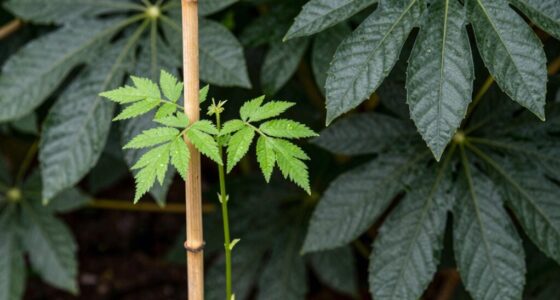
Yes, you can say that Mimosa pudica plants remember touch stimuli through complex signaling systems. When you touch the plant, it reacts by folding its leaves, but with repeated contact, this response becomes slower or less intense. This isn’t actual memory like humans have but a form of physiological adaptation involving changes in gene expression and signals. If you stick around, you’ll discover how these plants process touch and learn to respond more efficiently over time.
Key Takeaways
- Plants like Mimosa pudica can alter their responses after repeated touches, indicating a form of touch memory.
- Repeated stimuli cause physiological changes that reduce the plant’s immediate reactions over time.
- Touch stimuli influence internal signaling pathways and gene expression, enabling plants to “remember” past touches.
- This adaptive behavior helps Mimosa pudica conserve energy and respond efficiently to environmental stimuli.
- The ability to remember touch challenges traditional views, highlighting plants’ complex signaling and adaptive systems.

Scientists have discovered that plants can remember touch stimuli, challenging long-held beliefs about their responsiveness. This revelation opens new doors in understanding how plants interact with their environment. When you gently brush against a plant, you might think it simply reacts by moving or closing its leaves. But recent research suggests there’s more happening beneath the surface. Plants use a complex system called plant signaling to detect and respond to touch stimuli, which triggers a cascade of electrical and chemical signals. These signals help the plant adapt, not just momentarily, but in a way that influences future responses. This process, known as touch adaptation, means that plants can modify their behavior based on previous experiences with touch.
Plants can remember touch stimuli and adapt their responses, revealing a surprising level of environmental awareness.
Imagine walking through a garden and brushing against a sensitive plant like Mimosa pudica. At first, it folds its leaves in response, a quick and visible reaction. But what you might not realize is that with repeated touches, the plant begins to respond differently. It might close its leaves more slowly or stay open longer after a touch, indicating that it has “remembered” the stimulus. This form of memory isn’t like human memory but is a type of physiological adaptation. The plant adjusts its sensitivity, likely through changes in its signaling pathways, to prevent overreacting to harmless stimuli and conserve energy.
Your interaction with plants can influence their behavior over time. When they encounter frequent touch stimuli, they undergo a form of touch adaptation, making them less reactive to continued contact. This is an efficient survival strategy, allowing plants to avoid unnecessary energy expenditure on minor stimuli. Their ability to remember touch stimuli also involves altering gene expression, which affects how they respond to future touches. So, each new contact doesn’t just cause a reflex but is processed by the plant’s signaling network, leading to a modified response. Additionally, scientists are exploring how plant memory can be harnessed to improve agricultural practices and plant resilience.
Understanding plant signaling and touch adaptation helps demystify what might seem like simple reactions. It reveals a sophisticated communication system within plants that enables them to “learn” from past experiences. As you observe plants like Mimosa pudica, keep in mind that their responses are part of a complex, adaptive process. They aren’t just reacting blindly; they’re processing touch stimuli, storing information, and adjusting their behavior accordingly. This insight challenges the idea that plants are passive organisms and highlights their remarkable ability to remember and adapt, revealing a new level of plant intelligence that continues to fascinate scientists and enthusiasts alike.

Mimosa pudica, Sensitive Plant, Touch-Me-Not, Bashful, Houseplant, Cnt Sz: 3"
- Size at Arrival: 4-6 inches tall with mature foliage
- Interactive Movement: Foliage folds when touched, then opens
- Rare Houseplant: Available live, not just seeds
As an affiliate, we earn on qualifying purchases.
As an affiliate, we earn on qualifying purchases.
Frequently Asked Questions
Can Mimosa Plants Recognize Individual Humans?
Yes, mimosa plants can recognize individual humans through plant signaling and sensory adaptation. When you repeatedly touch a mimosa, it learns to ignore that stimulus, demonstrating sensory adaptation. Over time, it may even distinguish specific people based on subtle cues like touch patterns or frequency. This ability shows that plants, including mimosa, can form connections and adapt to their environment, effectively recognizing individual humans through their unique interactions.
Do Other Plants Exhibit Similar Memory Responses?
Yes, other plants exhibit similar memory responses through chemical signaling and neural analogs. When disturbed, they often respond more quickly or strongly to repeated stimuli, showing a form of learning. You can observe this in plants like peas or beans, which adapt their growth based on past experiences. This suggests that, although they lack brains, plants use chemical signaling and neural analogs to “remember” and respond to environmental cues effectively.
How Long Does the Memory of Touch Last in Plants?
Ever wonder how long plants remember touch? The memory lasts for a few minutes to hours, depending on plant signaling and sensory adaptation. When a plant experiences touch, it adjusts its response, but this memory fades as signals reset. This quick adaptation helps plants avoid overreacting, conserving energy. So, while plants can “remember” briefly, their memory isn’t long-lasting like ours—it’s a clever survival tactic.
What Mechanisms Enable Plants to Remember Stimuli?
You can understand that plants remember stimuli through chemical signaling and neural analogs. When touched, plants release chemicals that strengthen or weaken their responses over time, acting like a memory. These chemical signals serve as internal messengers, enabling plants to “remember” past stimuli. Although they lack a nervous system, their ability to process and respond based on chemical cues functions similarly to neural analogs, allowing them to adapt to repeated touches.
Can Plant Memory Be Affected by Environmental Changes?
Think of plant memory as a delicate dance with their environment; environmental changes can definitely influence it. When conditions shift, plant signaling pathways adapt, altering how memories form or fade. You’ll notice that stress, temperature, or light changes can either strengthen or weaken their ability to remember previous stimuli, showcasing their remarkable environmental adaptation. So, yes, your plants’ memories are dynamic, constantly shaped by the world around them.
Mimosa pudica, Sensitive Plant, Touch-Me-Not, Bashful, Houseplant, Cnt Sz: 3"
- Size at Arrival: 4-6 inches tall with mature foliage
- Interactive Movement: Foliage folds when touched, then opens
- Rare Houseplant: Available live, not just seeds
As an affiliate, we earn on qualifying purchases.
As an affiliate, we earn on qualifying purchases.
Conclusion
So, next time you gently brush a plant’s leaves, remember it might just remember that touch. It’s easy to think plants don’t have memories, but their responses suggest otherwise. Imagine your favorite plant “learning” from your touch, adjusting over time. This isn’t just about science — it’s about recognizing that even in the quietest green life, there’s a subtle, surprising form of memory waiting to be discovered.

Abiotic Stress Signaling and Responses in Plants
As an affiliate, we earn on qualifying purchases.
As an affiliate, we earn on qualifying purchases.

Plant Growing Science Kit for Kids – 19 Botany Experiments with Hydroponic Growing, Root Science & Transpiration – STEM Gardening Gift for Boys & Girls – Birthday Gift Ages 8, 9, 10, 11, 12
- Number of Experiments: 19 real botany experiments
- Unique Growing Methods: Hydroponic and root science activities
- Educational Focus: Teaches plant biology and science concepts
As an affiliate, we earn on qualifying purchases.
As an affiliate, we earn on qualifying purchases.