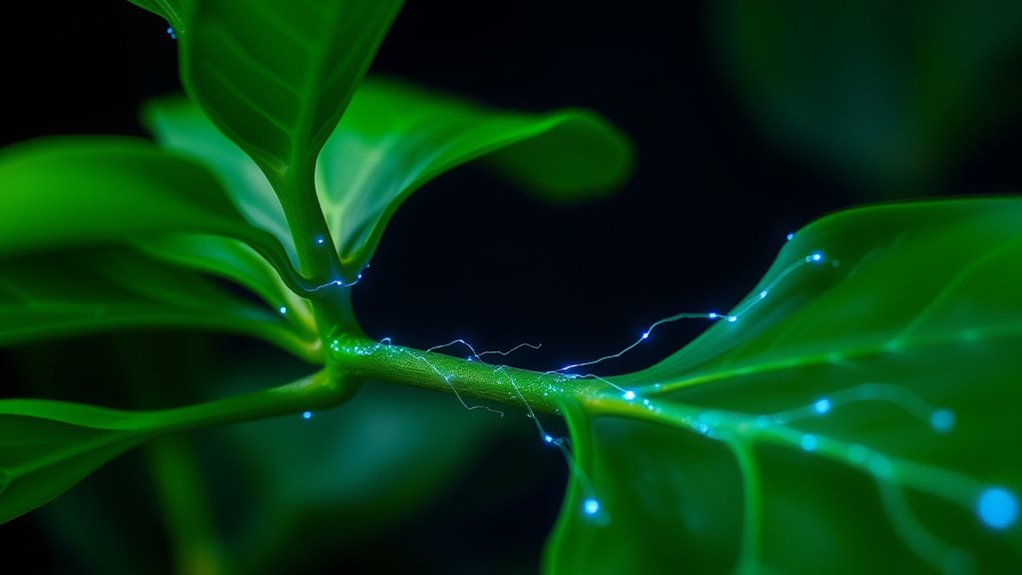

Plants generate electrical signals through ion movement across their membranes, acting like tiny nerves. These bioelectrical impulses quickly travel through stems and leaves, triggering responses like closing stomata or releasing deterrents against pests. They also communicate internally to coordinate defense and can send warning signals to neighboring plants through soil or air. Understanding these electrical pathways reveals how plants actively respond to their environment, and exploring further will uncover even more fascinating details about their signaling systems.

Get the little things that make your day delivered free — and shop member deals
- Fast, free delivery on millions of items
- Access to Prime Big Deal Days deals on October 6–7
- Prime Video, Amazon Music and more included
Key Takeaways
- Plants generate electrical impulses via ion movement, acting as internal communication signals in stems and leaves.
- Electrical signals travel swiftly through vascular tissues like phloem and xylem, coordinating defense responses.
- These impulses trigger production of chemicals, stomatal closure, and other protective mechanisms in plant tissues.
- Electrical signals can also be transmitted to neighboring plants through soil or air, enabling collective defense.
- Bioelectrical signaling reveals plants as active organisms with complex communication networks across stems and leaves.

Have you ever wondered how plants communicate or respond to their environment? It might surprise you to learn that plants are far from silent. They send and receive signals through complex bioelectrical processes, allowing them to adapt, defend, and even warn neighboring plants of danger. This form of plant communication relies heavily on signal transmission mechanisms that operate within their stems and leaves. These electrical signals are generated by the movement of ions across cell membranes, creating tiny electrical impulses similar to nerve signals in animals. When a plant experiences stress—such as insect attack, drought, or physical injury—it triggers a cascade of electrical signals that travel through its tissues.
Understanding these signal transmission mechanisms is key to grasping how plants respond so swiftly to changing conditions. When a leaf is damaged, for instance, specialized cells detect the injury and generate electrical impulses. These impulses move rapidly through the plant’s vascular system, particularly via the phloem and xylem tissues. As the signals propagate, they activate defense responses—like producing toxic chemicals to deter pests or closing stomata to reduce water loss. This quick communication ensures the plant can mount a coordinated response long before the damage becomes severe. Unlike animals, plants lack a nervous system, but their bioelectrical signaling pathways serve a similar purpose, allowing them to process and respond to environmental stimuli efficiently.
Plants rapidly transmit electrical signals through vascular tissues to activate defenses before damage worsens.
Plant communication isn’t limited to internal signaling; it also extends to neighboring plants. Certain bioelectrical signals can travel through the soil or air, alerting nearby plants of potential threats. This form of communication can trigger preemptive defenses, such as strengthening cell walls or releasing protective chemicals, providing a survival advantage. Researchers have identified that these electrical signals can be transmitted over considerable distances within the plant, sometimes spanning several meters, depending on the species and conditions. These mechanisms highlight that plants are highly responsive organisms, capable of sensing their surroundings and transmitting essential information through a sophisticated network of electrical impulses.
In essence, the study of bioelectrical signals in plants reveals a hidden layer of communication that’s both intricate and crucial for their survival. It’s a dynamic system where electrical impulses act as messengers, coordinating responses from the tiniest leaves to the thickest stems. By understanding these processes, you gain insight into how plants are active, responsive beings, capable of complex interactions with their environment. Their ability to transmit signals efficiently ensures they survive and thrive amid the challenges of their habitats, proving that even rooted organisms can have remarkable communication networks.
As an affiliate, we earn on qualifying purchases.
Frequently Asked Questions
How Do Environmental Changes Affect Plant Bioelectrical Signals?
Environmental impact causes your plant’s bioelectrical signals to vary, making them more or less active depending on conditions. Changes like temperature, light, or humidity influence signal variability, signaling stress or adaptation. When environmental factors shift, you’ll notice alterations in electrical activity, helping you understand how your plant responds. Monitoring these signals offers insight into plant health, allowing you to adjust care accordingly for ideal growth.
Can Bioelectrical Signals Predict Plant Stress or Disease?
A stitch in time saves nine, and recognizing plant stress indicators can save your crops. Yes, bioelectrical signals can predict plant stress or disease, acting as early warning systems. By monitoring these signals, you can detect disease and stress before visible symptoms appear. This proactive approach enhances disease detection, ensuring healthier plants and better yields. Trust these electrical clues—they’re your plants’ secret language for health and trouble.
What Equipment Is Used to Measure Electrical Activity in Plants?
You use specialized equipment like microelectrodes and surface electrodes to measure electrical activity in plants. These electrodes, made of materials like platinum or carbon, detect bioelectrical signals from stems and leaves. You connect them to data acquisition systems, which record and analyze the signals. This setup helps you understand plant responses, stress, and health by capturing real-time electrical activity accurately and efficiently.
Are Bioelectrical Signals in Plants Similar to Animal Nerve Signals?
Think of plant bioelectrical signals as a quiet symphony, not like the rapid-fire nerve signals in animals. While there’s a plant nerve analogy, the electrical signal mechanisms differ markedly; plants use slower, chemical-based signals to respond to stimuli. You can appreciate that, like a gentle whisper instead of a shout, these signals coordinate plant functions without the rapid transmission seen in animal nervous systems.
How Do Plant Age and Species Influence Bioelectrical Responses?
You’ll find that plant development and species variation substantially influence bioelectrical responses. As plants age, their electrical signals often become stronger or more complex due to increased tissue differentiation. Different species exhibit unique bioelectrical patterns, reflecting their specific adaptations and growth stages. So, understanding plant development and species variation helps you interpret electrical signals accurately, revealing insights into their health, stress responses, and overall physiological processes.
plant bioelectrical communication kit
As an affiliate, we earn on qualifying purchases.
As an affiliate, we earn on qualifying purchases.
Conclusion
As you observe the gentle flow of bioelectrical signals weaving through stems and leaves, you realize they’re like silent currents shaping life’s intricate dance. These hidden electrical whispers pulse with essentiality, connecting every part of the plant’s delicate tapestry. By understanding these subtle signals, you glimpse the vibrant symphony of nature’s unseen energy. It’s a reminder that beneath the quiet surface, a complex, vibrant world of communication quietly sustains life’s delicate balance.
As an affiliate, we earn on qualifying purchases.
As an affiliate, we earn on qualifying purchases.
Fall Picks
fall essentials
As an affiliate, we earn on qualifying purchases.