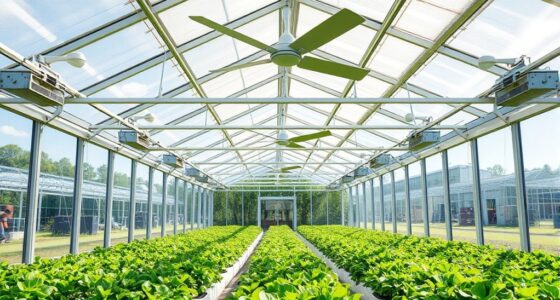
In aquaponics, you combine fish farming and plant growth in a natural cycle, where fish waste provides nutrients for plants, and bacteria help convert waste into usable forms. Hydroponics, however, grows plants directly in nutrient solutions, giving you precise control over nutrients and pH. Both have unique benefits—aquaponics is eco-friendly and sustainable, while hydroponics offers faster growth and higher yields. Exploring these differences further can help you choose the best system for your goals.
Key Takeaways
- Aquaponics combines fish and plants, relying on biological nutrient cycles, while hydroponics uses controlled nutrient solutions without fish.
- Fish health directly impacts nutrient availability in aquaponics, whereas hydroponics depends on precise nutrient management.
- Aquaponics offers a natural, eco-friendly system with lower chemical use; hydroponics allows faster growth through precise nutrient control.
- Aquaponics requires ongoing monitoring of water quality and fish health; hydroponics focuses on maintaining nutrient solution pH and concentration.
- Both systems promote sustainable farming but differ in complexity, maintenance, and dependency on biological versus chemical processes.

Have you ever wondered how soilless farming methods compare? When choosing between aquaponics and hydroponics, understanding how each system manages fish health and nutrient cycles can help you make an informed decision. In aquaponics, fish health is at the core of the system’s success. Healthy fish produce nutrient-rich waste that fuels plant growth, creating a symbiotic relationship. If fish become stressed or unhealthy, their waste production drops, and the entire system’s balance is disrupted. That’s why monitoring water quality, oxygen levels, and fish feeding routines is vital. Keeping fish healthy ensures a steady supply of nutrients and prevents diseases that can spread quickly in a closed environment. With proper care, aquaponics can be a sustainable system that mimics natural ecosystems, reducing the need for synthetic fertilizers. Additionally, maintaining optimal refresh rates in monitoring equipment can improve system responsiveness and stability.
Nutrient cycles are also a key difference between aquaponics and hydroponics. In aquaponics, nutrients are derived from fish waste, which naturally cycles through the system. Bacteria play an essential role by converting fish waste into forms that plants can absorb, like nitrates and nitrites. This biological process is fundamental to maintaining a balanced nutrient cycle. If any part of this cycle is disrupted—say, by overfeeding the fish or poor filtration—the plants may not receive adequate nutrients, and water quality can deteriorate. Properly managing these nutrient cycles requires ongoing attention to both fish health and bacterial activity, making aquaponics a delicate but rewarding system.
On the other hand, hydroponics doesn’t depend on fish; instead, it relies on a carefully controlled nutrient solution. You have the flexibility to precisely adjust nutrient concentrations and pH levels, which can lead to faster plant growth and higher yields. However, you also have to be vigilant about maintaining the nutrient solution, replacing it regularly to prevent deficiencies or toxic buildup. Since no fish are involved, the system isn’t affected by fish health, but it also means you miss out on the natural nutrient recycling process that aquaponics offers. This often results in a more straightforward setup, but it may require more manual input and monitoring of nutrients.
Frequently Asked Questions
What Are the Initial Setup Costs for Aquaponics Compared to Hydroponics?
You’ll find that aquaponics generally has higher initial setup costs compared to hydroponics due to equipment expenses. The cost comparison shows you need a fish tank, grow beds, plumbing, and water pumps, which add up quickly. Hydroponics usually requires only grow trays, nutrient solutions, and pumps, making it more affordable upfront. If budget is a concern, hydroponics might be the better choice for your starting investment.
How Do Maintenance Requirements Differ Between Aquaponics and Hydroponics Systems?
You’ll find aquaponics requires less maintenance than hydroponics, but it’s still a beast! You’ll need to vigilantly monitor nutrients and manage pest control, especially since fish health hinges on water quality. Hydroponics demands frequent nutrient monitoring and pest management, but it’s more straightforward. In aquaponics, balancing fish and plants can be a daily chore, while hydroponics keeps you focused on nutrient levels and pest threats.
Which System Is More Scalable for Commercial Farming?
Hydroponics generally offers better scalability for commercial farming because it faces fewer scalability challenges and allows easier farm expansion. You can quickly increase production by adding more growing units without complex adjustments. Aquaponics, while sustainable, requires careful balancing of fish and plants, making large-scale expansion more complex. If you prioritize straightforward farm expansion, hydroponics provides a more flexible option, especially for scaling up operations efficiently.
Are There Specific Crops Better Suited for Aquaponics or Hydroponics?
You’ll find that crop compatibility greatly influences whether aquaponics or hydroponics suits your needs. Leafy greens, herbs, and small vegetables thrive in hydroponics due to their fast-growing preferences and straightforward nutrient requirements. Aquaponics works well for fish-friendly crops like lettuce and certain herbs, but it requires balancing fish health with plant growth. Consider your growing preferences and the specific crops you want to produce to choose the best system.
How Do Environmental Impacts Compare Between the Two Methods?
You’ll find that aquaponics generally has a lower environmental impact due to better waste management, as fish waste naturally fertilizes plants, reducing runoff and pollution. Both methods conserve water, but aquaponics often uses less because of its closed-loop system. This makes aquaponics more eco-friendly overall. Hydroponics can require more frequent water replacement and chemical nutrients, increasing environmental concerns. So, if sustainability matters, aquaponics might be the better choice.
Conclusion
So, whether you prefer the eco-friendly charm of aquaponics or the straightforward efficiency of hydroponics, remember that both systems have their quirks. It’s amusing how one relies on fish while the other on chemicals—yet both aim for lush, healthy plants. In the end, it’s almost poetic how we’ve created two worlds of growth, each claiming to be the greener choice, when really, they’re just different paths to the same goal: greener thumbs.