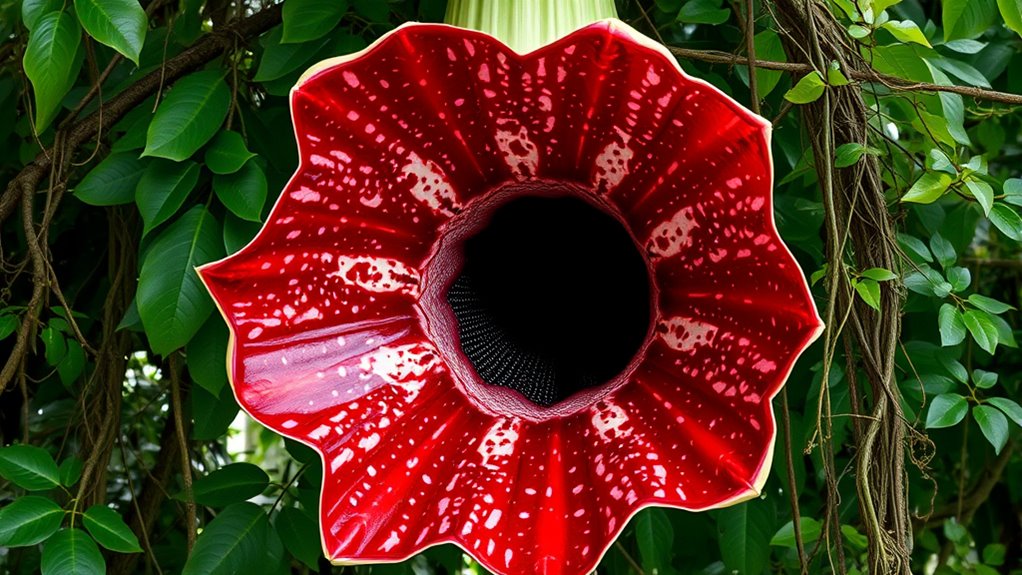
Rafflesia, the world’s largest flower, surprises many with its parasitic lifestyle, lacking leaves, roots, and stems. It depends entirely on host vines, mainly Tetrastigma, for water and nutrients, growing embedded within the host. Its grotesque appearance and foul odor attract carrion flies for pollination, making insect behavior essential for reproduction. If you’re curious about how this rare plant survives and reproduces in such niche environments, you’ll find many intriguing details as you continue to explore.
Key Takeaways
- Rafflesia is the largest flower in the world, notable for its enormous size and lack of leaves, stems, and roots.
- It is a parasitic plant that depends entirely on host vines, mainly Tetrastigma species, for water and nutrients.
- Rafflesia emits a foul odor resembling rotting flesh to attract carrion flies for pollination.
- Its reproductive success relies on specific insect behavior, as it does not produce nectar or scent for pollinators.
- The plant’s rarity is due to its specialized parasitic lifestyle and dependence on specific insect populations and ecological conditions.
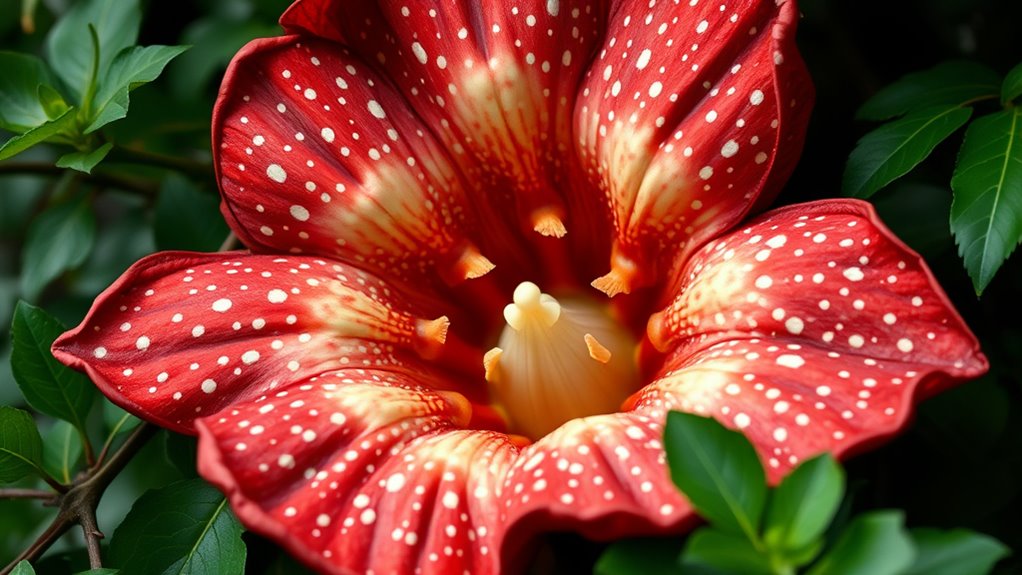
Have you ever wondered what makes the Rafflesia so extraordinary? It’s not just its status as the world’s largest flower, but also its unique way of living and reproducing. Unlike most plants that produce their own energy through photosynthesis, the Rafflesia is a parasitic plant. It has no leaves, roots, or stems of its own. Instead, it depends entirely on a host vine, usually a species of Tetrastigma, which it infiltrates and parasitizes for water and nutrients. This parasitic lifestyle means the Rafflesia has had to adapt in remarkable ways, especially when it comes to pollination strategies. Because it lacks leaves and chlorophyll, it doesn’t photosynthesize, so it produces no nectar or scent to attract pollinators in the traditional way. Instead, it relies on its appearance and smell to lure specific insects, primarily carrion flies, which are attracted to its foul odor. The Rafflesia emits a smell akin to rotting flesh, a clever adaptation that guarantees only certain insects attempt to pollinate it. The reliance on specific insect behavior is an extraordinary example of how parasitic plants have evolved specialized reproductive strategies. When a carrion fly lands on the bloom, it inadvertently picks up pollen and carries it to another Rafflesia flower, completing the reproductive cycle. This strategy is a fascinating example of parasitic plant adaptations working in tandem with insect behavior to guarantee survival. The flower’s massive size and putrid scent might seem grotesque, but they play vital roles in its reproductive success. The Rafflesia’s pollination process is a delicate dance; it depends heavily on the presence of specific insects and the timing of its bloom to maximize pollination chances. Because it relies on this specialized pollination strategy, its distribution is often limited to areas where the right insects are present, adding to its rarity. Its parasitic nature also influences its growth and development. Since it lacks chlorophyll, it can’t produce its own food, which is why it has evolved to embed itself within host vines so effectively. It’s a perfect example of parasitic plant adaptations that allow it to survive in nutrient-poor environments where other plants might struggle. In essence, the Rafflesia’s extraordinary size and parasitic lifestyle are intertwined with its specialized pollination strategies. These adaptations have allowed it to thrive in its niche, despite its seemingly grotesque appearance. Understanding how it reproduces highlights the incredible ways nature finds solutions to survival challenges, making the Rafflesia one of the most fascinating plants on Earth.
Frequently Asked Questions
How Does Rafflesia Detect Its Host Vines?
You might wonder how rafflesia detects its host vines. It does this through chemical signaling and root sensing, allowing it to identify the presence of host plants nearby. Rafflesia’s specialized structures sense chemical compounds released by the vines, guiding its growth toward them. This detection method helps the parasitic flower efficiently locate and attach to its host, ensuring it receives nutrients without needing roots of its own.
What Specific Plants Does Rafflesia Parasitize?
Imagine a silent thief lurking in the rainforest, and that’s exactly what Rafflesia does. It parasitizes specific plants like Tetrastigma vines, showcasing strict host vine specificity. Through its parasitic mechanisms, it taps into these host vines’ tissues, drawing nutrients without leaves or stems of its own. You can’t mistake its target; Rafflesia only parasitizes particular vines, ensuring it’s perfectly adapted to its specialized host environment.
How Long Does Rafflesia Take to Bloom After Infection?
You’ll find that rafflesia takes about 9 to 12 months to bloom after infection. During this period, its pollination strategies rely on specific insects, like carrion flies, attracted to its foul odor. Seed dispersal mechanisms involve animals or insects aiding in spreading the tiny seeds, ensuring the parasitic plant can infect new hosts. This lengthy development emphasizes its unique parasitic and reproductive adaptations.
Are There Any Conservation Efforts for Rafflesia Species?
Yes, conservation efforts for Rafflesia species are ongoing. You can support ecotourism initiatives that promote responsible viewing, which helps fund protection programs. Local community involvement is vital; it encourages residents to preserve their natural habitats and participate in conservation actions. By visiting these sites responsibly, you help raise awareness, reduce illegal collection, and guarantee that Rafflesia populations thrive for future generations.
Can Rafflesia Reproduce Without Pollinators?
No, rafflesia can’t reproduce without pollinators because pollination mechanisms are essential for its genetic reproduction. You’ll find that these plants rely on specific insects to transfer pollen from one bloom to another. Without pollinators, the chances of successful reproduction drop considerably. This dependence on insects highlights the importance of conserving their habitats, ensuring that pollination mechanisms continue to support the rafflesia’s life cycle.
Conclusion
Now that you’ve uncovered the secrets of Rafflesia, you realize you’ve seen nothing yet. This monstrous bloom, the size of a small car, isn’t just a flower—it’s a legendary giant lurking in the jungle, defying everything you thought you knew about plants. Its parasitic power and mind-blowing size make it the ultimate botanical beast. Next time you wander into the rainforest, keep an eye out—you might just stumble upon the world’s most astonishing floral giant!