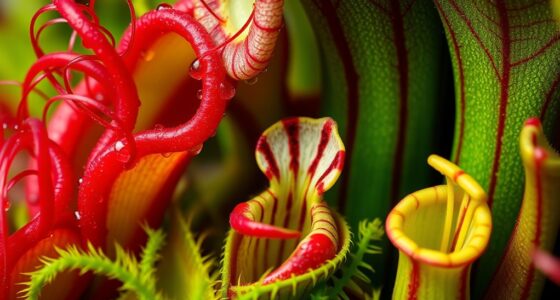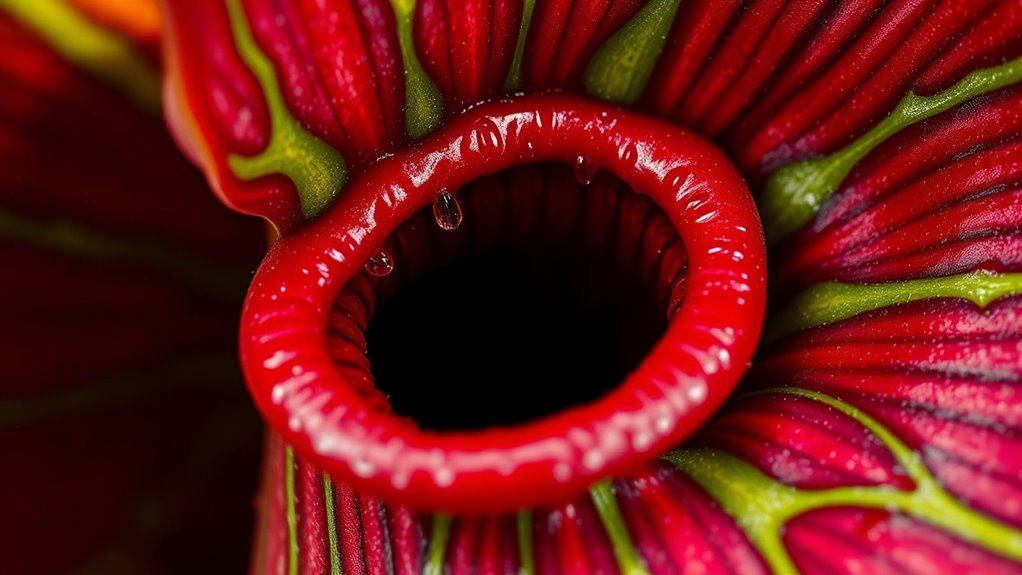

Inside Attenborough’s pitcher plant, you’ll see a tubular, colorful structure designed to trap insects. You can observe how its nectar-filled rim lures prey, while the smooth, waxy surface causes insects to slip and fall into a deep cavity lined with downward hairs. Inside, digestive enzymes and bacteria break down the trapped insects, providing essential nutrients. If you keep exploring, you’ll uncover how this incredible plant turns survival into an art form.
Key Takeaways
- The pitcher plant uses vibrant colors and nectar on its peristome to attract insects.
- Its slippery, waxy surface causes insects to slip into the deep, liquid-filled cavity.
- Downward hairs prevent trapped insects from escaping once inside.
- Digestive enzymes and bacteria break down insects to release vital nutrients.
- The plant’s structure exemplifies an evolutionary adaptation for survival in nutrient-poor environments.

Have you ever wondered how some plants trap insects to survive? Attenborough’s Pitcher Plant is a perfect example of nature’s ingenuity. This remarkable carnivorous plant has evolved a deadly trap to supplement its nutrient intake in the nutrient-poor soils where it grows. Its tubular, pitcher-shaped leaves are more than just a simple container; they’re a sophisticated hunting device designed to lure, trap, and digest insects. As you observe it, it’s clear that every detail serves a purpose, from the color patterns to the slippery surfaces.
The plant’s vibrant, nectar-filled rim, called the peristome, acts as an irresistible lure, drawing insects to its edge. When a bug lands on the peristome, it’s met with a slick, often waxy surface that makes escape nearly impossible. The plant’s surface is specially coated to be extremely slippery, causing insects to lose their footing and fall into the deep, dark interior of the pitcher. Inside, the walls are often lined with downward-pointing hairs, which prevent any trapped insect from crawling back out. This design guarantees insects remain trapped once they’ve fallen in, making escape a near-impossible feat.
Once an insect tumbles into the pitcher, it finds itself in a liquid-filled cavity at the bottom, which contains digestive enzymes and bacteria. The plant actively secretes enzymes that break down the soft tissues of its prey, releasing essential nutrients like nitrogen and phosphorus. These nutrients are scarce in the plant’s native environment, so capturing insects provides a critical supplement to its diet. Interestingly, some pitcher plants also have symbiotic bacteria that aid in the digestion process, making nutrient extraction even more efficient. As the digestion process unfolds, the plant absorbs these nutrients, fueling its growth and reproduction.
What’s truly fascinating is how Attenborough’s Pitcher Plant balances its deadly trap with subtle beauty. The vibrant colors and intricate patterns on the rim act as visual lures, guiding insects toward the trap. Despite its lethal nature, the plant’s design is a marvel of evolution, showcasing how life adapts to even the most challenging conditions. You can’t help but marvel at how this plant turns what seems like a simple pitcher into a precise, deadly mechanism. It’s a perfect example of nature’s ability to innovate, transforming survival into an art form that’s both beautiful and deadly.

Fielda 8/10/12 Inch Self Watering Pots for Indoor/Outdoor Plants
- Self-Watering System: Automatic water draw with level indicator
- Water Level Monitoring: Transparent window with measurement marks
- Long Moisture Duration: Keeps soil moist for 7-10 days
As an affiliate, we earn on qualifying purchases.
Frequently Asked Questions
How Long Does It Take for the Plant to Digest Its Prey?
It typically takes about 4 to 6 days for the pitcher plant to digest its prey completely. You’ll notice the process begins soon after the insect falls in, as the plant secretes enzymes that break down the body. During this time, the plant absorbs nutrients from the decomposing prey, which helps it thrive in nutrient-poor environments. The digestion period can vary depending on prey size and environmental conditions.
Can the Pitcher Plant Survive Without Consuming Insects?
You might wonder if the pitcher plant can survive without eating insects. Yes, it can, but its growth and health suffer over time. For example, in a greenhouse experiment, plants deprived of prey showed stunted growth and fewer flowers. The plant relies on insects for essential nutrients like nitrogen, which it can’t produce on its own. Without prey, it struggles to thrive, though it can survive temporarily.
Are There Any Known Predators of the Pitcher Plant?
Yes, some animals can prey on pitcher plants. You might find insects like beetles or spiders crawling inside, sometimes damaging the plant’s structure. Additionally, herbivorous animals such as deer or rodents may nibble on the leaves or stem, harming the plant’s ability to thrive. While pitcher plants are designed to trap insects for nutrients, they aren’t entirely safe from predators or damage caused by other creatures in their environment.
How Does the Plant Attract Its Prey?
You’re standing before a marvel of nature’s ingenuity, and the pitcher plant pulls prey in with mesmerizing nectar and vibrant colors. Its seductive scent acts like a siren song, luring insects closer and closer. When they land on the rim, slick surfaces and downward-pointing hairs make escape impossible. As you watch, it’s clear this plant’s attraction is a deadly, irresistible trap, perfectly designed to capture unwary prey.
Is the Pitcher Plant Endangered or at Risk of Extinction?
You’ll find that pitcher plants are generally not endangered globally, but some species face threats due to habitat loss and overcollection. In certain regions, their populations are declining, making them vulnerable or at risk of extinction. Conservation efforts are vital, so you can support organizations working to protect their habitats. By doing so, you help guarantee these fascinating plants continue to thrive in the wild for future generations.

Back to the Roots Self-Watering Terracotta Olla Pot (Pack of 3), 700mL Provides 1 Week of Precision Watering
- Plant Coverage Diameter: 18 inches for 2 large plants
- Weather-Proof Stopper: Prevents evaporation
- Capacity: 700 mL for weekly watering
As an affiliate, we earn on qualifying purchases.
Conclusion
As you explore Attenborough’s pitcher plant, you realize it’s a masterful predator, a silent assassin cloaked in beauty. Its deadly trap is like a velvet coffin, luring prey into a world from which there’s no escape. This plant reminds you that nature’s elegance often conceals a ruthless survival game. In its deadly embrace, you see the delicate balance of life and death—a reminder that beauty can be a mask for danger, waiting patiently in the shadows.