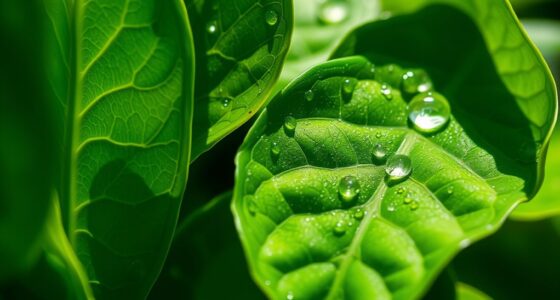

Plant cells stay rigid thanks to their tough cell walls made of cellulose, which act like a sturdy shell around the cell. Inside, water fills the central vacuole and creates turgor pressure, pushing outward against the wall and making the plant firm and upright. The wall and internal pressure work together to support the plant without bones. If you’re curious, there’s more about how these structures adapt and grow over time.
Key Takeaways
- Plant cells have a sturdy cell wall made of cellulose that provides structural support.
- Turgor pressure from water filling the central vacuole pushes against the cell wall, maintaining rigidity.
- Water absorption ensures internal pressure, keeping the plant upright and firm.
- The cell wall can remodel and adapt, allowing growth without losing integrity.
- The synergy of the cell wall and turgor pressure replaces bones, supporting plant structure and resilience.

Plant cells stay rigid thanks to their cell walls, which provide essential support and structure. Unlike animals, which rely on bones for rigidity, plant cells have a tough, protective outer layer called the cell wall. This wall is primarily made of cellulose, a complex carbohydrate that forms a strong, flexible shell around the cell. The cell wall acts like a sturdy frame, preventing the cell from collapsing or deforming under external forces. It’s the key to maintaining the plant’s upright posture, even when the plant is heavy with water or subjected to wind and rain.
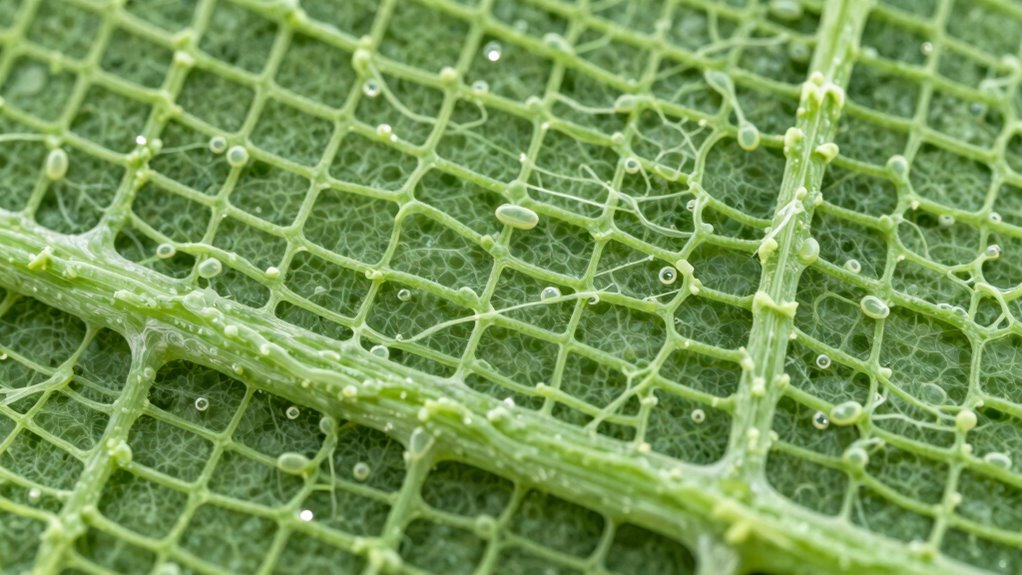
Plant cell walls are tough, flexible structures made of cellulose that support and protect the cell.
The cell wall works closely with turgor pressure, a crucial force generated inside the cell. When your plant absorbs water through its roots, the water fills the central vacuole—a large, fluid-filled sac inside the cell. As the vacuole swells, it pushes against the cell wall, creating turgor pressure. This internal pressure acts like an internal balloon, pressing outward and giving the cell its shape. When turgor pressure is high, the cell becomes firm and rigid, helping the plant stay upright and stand tall. If the plant loses water, turgor pressure drops, and the plant wilts. That’s why keeping the right water balance is essential for maintaining rigidity.
Your plant’s cell wall isn’t just a static structure; it’s dynamic and adaptable. When the plant needs to grow taller or wider, cells can modify their walls by loosening and remodeling cellulose fibers. This flexibility allows the plant to expand without losing structural integrity. Additionally, the cell wall’s composition can change depending on the plant’s growth stage or environmental conditions, demonstrating its adaptive nature. This ongoing remodeling process is vital for healthy growth and resilience.
In essence, the combination of a strong cell wall and the pressure from water inside the cell keeps plant cells firm and stable. This synergy allows plants to grow upright, resist external forces, and maintain their shape without bones. By controlling turgor pressure and maintaining a resilient cell wall, plants can adapt to their environment, stand tall, and thrive. You can think of the cell wall as a protective armor that holds everything together, while turgor pressure provides the internal push that keeps the plant firm and upright. Together, they form an effective system that replaces the need for bones, ensuring plants stay rigid and resilient in a variety of conditions.
plant cell wall support structures
As an affiliate, we earn on qualifying purchases.
As an affiliate, we earn on qualifying purchases.
Frequently Asked Questions
Do Plant Cells Ever Lose Their Rigidity?
Yes, plant cells can lose their rigidity if their cell wall composition weakens or if turgor pressure regulation fails. When the cell wall becomes damaged or the regulation of water balance falters, the cell can’t maintain its shape. You might notice wilting or drooping in plants. Proper cell wall composition and turgor pressure regulation are essential for keeping plant cells firm and maintaining overall plant structure.
How Do Plant Cells Repair Damage to Their Cell Walls?
When your plant cells get a boo-boo, they spring into action, like tiny repair crews armed with enzymatic repair. They initiate cell wall synthesis, building new layers to patch up the damage, ensuring the wall remains sturdy. Think of it as a microscopic construction site, where enzymes act as workers swiftly fixing cracks. This process keeps your plant upright and resilient, even after the occasional nudge or scrape.
Can Plant Cells Be Flexible Under Certain Conditions?
Yes, plant cells can be flexible under certain conditions. Cell wall elasticity allows them to bend without breaking, especially during growth or environmental stress. This flexibility results from structural adaptations in the cell wall, which can loosen or tighten as needed. When conditions favor, the cell wall becomes more elastic, enabling the plant to adapt to its surroundings while maintaining overall integrity and allowing for controlled movement or growth.
What Role Do Minerals Play in Cell Wall Strength?
Minerals play a vital role in cell wall strength through mineral reinforcement and cell wall fortification. When minerals like calcium and magnesium deposit in the cell wall, they create strong cross-links between cellulose fibers, enhancing rigidity. This mineral reinforcement prevents the wall from breaking under pressure, maintaining the plant’s structural integrity. By fortifying the cell wall, minerals guarantee your plant remains sturdy and resilient against environmental stresses.
How Do Plant Cells Differentiate Their Rigidity Across Tissues?
Coincidentally, plant cells differentiate their rigidity through variations in cell wall composition and turgor pressure regulation. You notice that some tissues, like wood, have thicker, lignin-rich walls for strength, while others, like leaves, prioritize flexibility. By adjusting cell wall components and controlling turgor pressure, you enable specific tissues to remain rigid or flexible, ensuring proper growth, support, and function across different plant parts.
As an affiliate, we earn on qualifying purchases.
Conclusion
So, next time you marvel at a towering tree or a delicate flower, remember that plant cells are like tiny fortresses, holding their ground with a sturdy cell wall and turgor pressure. They’re proof that strength isn’t always about bones or muscles but about resilience and adaptation. Like a silent guardian, your plant’s cells remind you that true rigidity comes from within — a quiet power that holds everything together, no matter what storms may come.
plant growth and support products
As an affiliate, we earn on qualifying purchases.
As an affiliate, we earn on qualifying purchases.

Super Starts Plant Tissue Culture
- Compact Plant Growth: Grow plants in small containers
- Space and Light Saving: Efficient use of space and light
- Rapid Propagation: See new shoots and roots quickly
As an affiliate, we earn on qualifying purchases.
As an affiliate, we earn on qualifying purchases.