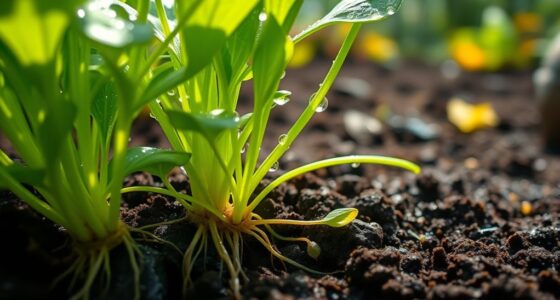
Fire followers are plants that rely on wildfires to trigger their seed germination. They have adapted to use heat and chemicals from fire, such as smoke, to break seed dormancy. When a fire occurs, it clears competition and creates ideal conditions with nutrient-rich soil, encouraging these plants to grow quickly. If you’re curious about how these unique plants depend on fire, keep exploring how their special adaptations help them thrive in burned landscapes.
Key Takeaways
- Fire followers rely on heat and smoke from wildfires to trigger seed germination.
- Their seeds have protective coatings or chemical cues activated by fire.
- Fire clears competition and enriches soil, creating ideal conditions for germination.
- These plants have evolved to depend on fire cues for synchronized, successful sprouting.
- Their lifecycle helps maintain plant diversity and resilience in fire-prone ecosystems.

Have you ever wondered what it means to be a fire follower? In the world of fire ecology, certain plants have evolved to thrive in the aftermath of wildfires, relying on the intense heat and smoke to trigger their germination. These fire followers are specially adapted to the cycle of burning landscapes, making them unique among plant species. Their survival depends on understanding how fire shapes their environment and how their seeds respond to these conditions. When a fire sweeps through an area, it clears out competition and creates a nutrient-rich, open space. Fire followers have developed seed adaptations that allow them to take advantage of these changes. Many of their seeds contain specialized coatings or chemical cues that only break down or activate when exposed to the heat or chemical signals from smoke. This guarantees they germinate at just the right time—when resources are abundant, and competition is minimal. If you look closely at some of these seeds, you might notice their hard, protective shells. These shells act as a barrier, preventing germination until the fire’s heat or ash alters their structure. In some cases, smoke chemicals serve as a signal that the environment has been reset, prompting seed germination. This adaptation is a perfect example of how evolution has tailored these plants to their fire-prone habitats. It’s fascinating to see how fire ecology has influenced plant development, turning what might seem destructive into a essential part of their life cycle. By relying on fire cues, these plants avoid germinating during less favorable conditions, such as drought or competition from established vegetation. Instead, they wait patiently, sometimes lying dormant for years, until a fire occurs. When that happens, their seeds respond quickly, sprouting into seedlings that quickly take advantage of the newly available space and nutrients. This cycle allows fire followers to maintain their presence in fire-prone ecosystems, guaranteeing their survival amid the natural disturbances that shape those landscapes. Understanding seed adaptation in fire ecology offers insight into how ecosystems recover and regenerate after fires. It also highlights the importance of fire management practices that preserve these natural processes. Without fire, many of these plants would struggle to reproduce, and entire communities could be altered or lost. So, next time you learn about wildfire effects, remember that fire followers play an essential role in maintaining the health and diversity of fire-adapted ecosystems. Their ability to sense and respond to fire cues underscores the remarkable ways plants have evolved to thrive in even the most challenging environments.
Frequently Asked Questions
Which Plant Species Are Most Dependent on Fire for Germination?
You’ll find that many fire-dependent plants, like certain conifers and chaparral species, rely on fire-adapted traits for germination. These plants often have thick seed coats or cones that open only after a fire, utilizing seed dispersal mechanisms triggered by heat or smoke. Fire clears competing vegetation, creating ideal conditions for their seeds to sprout, ensuring their survival and propagation in fire-prone ecosystems.
How Long Can Fire-Following Seeds Remain Dormant in the Soil?
Imagine a seed buried deep in the soil, patiently waiting beneath layers of ash and earth. Fire-following seeds can remain dormant for decades, thanks to seed dormancy and seed longevity. This resilience allows them to sprout when fire clears away competition and releases nutrients. Depending on the species, some seeds can stay viable for 20 to 50 years, waiting for the right conditions to germinate and thrive after a fire.
Do Fire Followers Only Grow in Specific Fire-Prone Regions?
No, fire followers don’t only grow in fire-prone regions. While they thrive in areas with regular fire suppression, they can also establish in places where fires are suppressed or absent, especially if invasive species alter the landscape. These plants adapt to various environments, but without fire, their seed germination struggles. Fire suppression can hinder their growth, allowing invasive species to take over and change the ecosystem dynamics.
How Do Fire Signals Trigger Seed Germination Chemically?
Fire chemical cues, such as specific compounds released during a fire, trigger seed germination by breaking seed dormancy triggers. When you encounter these cues, they activate enzymes that weaken seed coats and stimulate growth hormones, signaling that conditions are right for germination. This process guarantees that fire followers sprout after a fire, taking advantage of the cleared space and nutrient-rich ash, boosting their chances of survival and growth.
Can Fire-Following Plants Survive Without Periodic Fires?
You can’t have your cake and eat it too; fire-following plants rely on periodic fires to survive. Without fire, fire suppression prevents ecological succession, which these plants depend on for seed germination and growth. While some may persist temporarily, long-term survival is unlikely without fire, as their life cycle is intrinsically linked to fire events. So, without fires, these plants struggle to thrive and maintain their role in the ecosystem.
Conclusion
So, next time you see a wildfire, remember that fire followers aren’t just survivors—they’re reborn through flames, thriving where others perish. They rely on fire to open seeds, clear the way, and renew the land. Fire followers teach you that destruction can lead to new beginnings, that endings make space for fresh growth. Embrace the cycle of fire and renewal, understanding that sometimes, destruction is simply the start of something beautiful.