Carnivorous plants like Venus flytraps and pitcher plants evolved their meat-based diets because they grow in nutrient-poor soils that lack essential nutrients like nitrogen. They developed specialized traps, such as hinged leaves and slippery pitcher surfaces, to catch insects efficiently. Their structures help them supplement their poor soil nutrients through prey. By examining these adaptations, you can discover how nature turns challenges into survival advantages and learn even more fascinating details about their evolution.
Key Takeaways
- They developed specialized structures like hinged leaves and slippery traps to efficiently capture insects.
- Their nutrient-poor habitats drove evolution of meat-eating adaptations to supplement deficient soil nutrients.
- Physical features such as trigger hairs and deep pitcher chambers evolved to prevent prey escape.
- Their separation of pollination and prey capture areas minimizes the risk of catching pollinators.
- Over millions of years, these adaptations turned environmental scarcity into a successful meat-based diet.
Have you ever wondered how some plants manage to survive in nutrient-poor soils? Carnivorous plants like Venus flytraps and pitcher plants have developed incredible adaptations that allow them to thrive where others would struggle. Unlike typical plants that rely solely on soil nutrients, these species have evolved unique strategies to supplement their diets by capturing and digesting insects and other small creatures. Their success hinges on specialized pollination strategies and habitat adaptations that set them apart from most flora. These plants often display remarkable space-maximizing structures that enable efficient prey capture and reproduction in limited environments. Their success hinges on specialized pollination strategies and habitat adaptations that set them apart from most flora.
Pollination strategies are essential for these plants. Many carnivorous species attract pollinators with bright colors, sweet scents, or nectar rewards, ensuring they can reproduce without disturbing their prey-capturing mechanisms. For example, Venus flytraps produce flowers on tall stalks that grow away from their trapping leaves, minimizing the risk of insects getting caught before pollination. This separation allows pollinators to visit safely, while the plants still capture insects for nourishment. Pitcher plants, on the other hand, often produce flowers high above their pitcher traps, ensuring that pollinators can visit without falling prey. These distinct pollination tactics help them balance reproduction with feeding, demonstrating clever habitat adaptations that safeguard their pollination and nutrition needs simultaneously.
Many carnivorous plants use tall flowers away from traps to protect pollinators and balance feeding and reproduction.
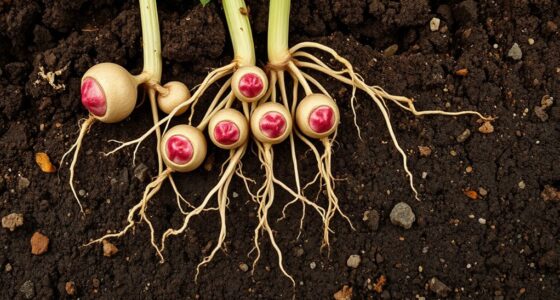
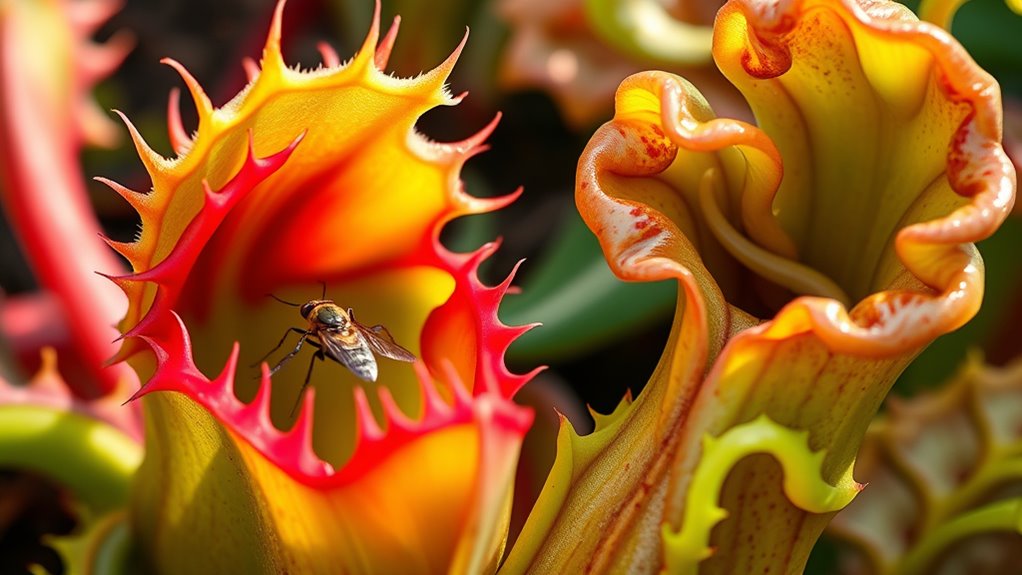
Habitat adaptations play a significant role in their survival. Carnivorous plants are often found in environments where the soil is poor in nitrogen and other essential nutrients, such as bogs, swamps, and rocky outcrops. To survive there, they’ve developed specialized structures. Venus flytraps, for instance, have hinged leaves with trigger hairs that snap shut when prey contacts them, allowing quick capture. Pitcher plants create deep, slippery traps filled with digestive fluids that lure insects in and prevent their escape. These physical adaptations are complemented by their ability to grow in acidic, nutrient-deficient soils, where other plants cannot compete. Their root systems are often shallow and less developed, as they rely more on capturing insects for nutrients rather than absorbing them from the soil.
In essence, the evolution of these remarkable plants hinges on their habitat adaptations and pollination strategies. They’ve transformed the challenge of nutrient scarcity into an advantage, turning insects into a essential part of their survival. Their unique mechanisms not only reflect their resilience but also showcase nature’s ingenuity. So, next time you see a Venus flytrap or pitcher plant, remember that their meat-based diets are the result of millions of years of adaptation—an extraordinary example of how life finds a way to flourish even in the most unlikely environments.
Frequently Asked Questions
How Do Carnivorous Plants Digest Their Prey?
You might wonder how carnivorous plants digest their prey. They use prey digestion through enzymatic breakdown, releasing powerful enzymes that dissolve proteins and other nutrients. When insects or small animals are trapped, the plants secrete these enzymes into their traps, effectively breaking down the prey’s tissues. This process allows the plants to absorb essential nutrients, especially nitrogen, crucial for their growth in nutrient-poor environments.
What Triggers a Venus Flytrap to Snap Shut?
You trigger a Venus flytrap to snap shut by touching its tiny hairs on the inner surface of the lobes, which are part of its prey detection methods. When you accidentally brush these sensors twice within about 20 seconds, the Venus flytrap’s mechanics activate, causing it to close rapidly. This quick response guarantees it captures prey efficiently, relying on these specialized trigger hairs to detect movement and presence.
Can Pitcher Plants Survive Without Catching Insects?
Like a car running without fuel, a pitcher plant can survive without catching insects, but it won’t thrive. Its root adaptations allow it to absorb nutrients from the soil, supporting its photosynthesis efficiency. However, without insects providing essential nutrients, the plant’s growth may slow, and it might struggle in poor soil conditions. So, while it can survive, catching insects greatly benefits its overall health and significance.
How Do These Plants Attract Their Prey?
You can see that pitcher plants attract prey through insect mimicry and nectar production. The plants produce sweet nectar to lure insects, and their shapes often mimic flowers or other insects, tricking prey into approaching. When insects get close, they slip into the pitcher’s slippery interior, making it easy for the plant to trap and digest them. This clever strategy guarantees the plant gets the nutrients it needs.
Are Carnivorous Plants Beneficial or Harmful to Their Ecosystems?
You might think carnivorous plants are villains, but they’re actually eco-heroes in disguise. They help control insect populations, reducing the need for chemical pesticides, and play a crucial role in plant conservation. However, pollution impact threatens their survival, risking ecosystem imbalance. By protecting these fascinating plants, you support biodiversity and a healthier environment, proving that even the smallest predators can be essential for ecological harmony.
Conclusion
So, next time you see a Venus flytrap or pitcher plant, remember—they’re just the overachievers of the plant world, proudly boasting about their meat-eating habits. While you’re busy munching on your salad, these plants are busy perfecting their murder skills. Who knew nature’s garden had such a dark side? So go ahead, admire their creepy elegance—after all, they’ve turned the art of plant-based dieting into a full-blown carnivorous spectacle. Nature’s true overachievers, indeed.