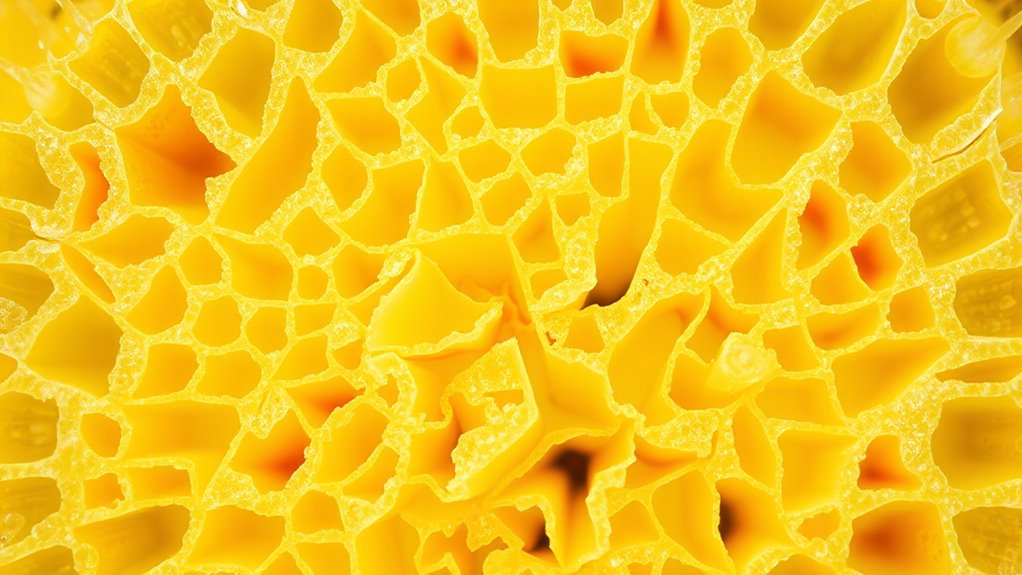

In stems, xylem and phloem form a crucial highway system that keeps your plant alive. Xylem transports water and minerals from roots to leaves using transpiration and cohesion, while phloem moves organic nutrients like sugars from leaves to other parts through pressure flow. Both tissues work together to guarantee your plant stays hydrated, energized, and healthy. If you’re curious about how these systems support plant growth, you’ll find plenty more to explore further.
Key Takeaways
- Xylem transports water and minerals upward; phloem carries organic nutrients like sugars throughout the plant.
- Xylem consists of dead, lignified hollow tubes; phloem is made of living cells including sieve tubes and companion cells.
- Water moves in xylem via transpiration-driven cohesion-tension; sugars move in phloem through pressure-flow mechanisms.
- Xylem provides structural support and hydration; phloem distributes energy-rich compounds for growth and storage.
- Both form an internal transport system, working together to sustain plant growth, resource distribution, and overall health.

Have you ever wondered how plants transport water and nutrients to survive? Inside the stems of plants, there’s a complex system that acts like a highway, moving crucial substances from one part of the plant to another. Two main players in this system are xylem and phloem. Though they work closely together, each has a unique role and structure, making the plant’s internal transport network efficient and effective.
Xylem primarily carries water and dissolved minerals upward from the roots to the leaves and other parts of the plant. Think of it as a series of hollow tubes made of dead, lignified cells, giving it strength and rigidity. These tubes are like water pipes that run throughout the plant, enabling a continuous flow driven by processes like transpiration — the evaporation of water from leaves. As water exits leaf pores, it creates a negative pressure that pulls more water upward through the xylem vessels. This process, called the cohesion-tension mechanism, relies on water molecules sticking together and to the walls of the xylem, creating a continuous column of water that can be pulled upward over long distances. Xylem vessels are also reinforced with lignin, making them sturdy enough to withstand the internal pressures involved in water transport. These vessels are usually long, tubular, and dead at maturity, optimized for efficient water conduction.
On the other hand, phloem has a different job: it transports organic nutrients, mainly sugars produced during photosynthesis, from the leaves to other parts of the plant where they are needed or stored. Unlike xylem, phloem consists of living cells that form a network of sieve tubes and companion cells. These sieve tubes are specialized for quick, flexible movement of nutrients. The process driving this movement is called translocation, which works on a pressure-flow mechanism. In this system, sugars are loaded into the phloem at sources like leaves, creating osmotic pressure that draws water in from neighboring xylem vessels. This increases pressure within the phloem, pushing the sugary sap toward sinks — areas like roots, fruits, or growing shoots — where sugars are used or stored. The sugars then exit the phloem, and water follows, maintaining the flow. This system allows the plant to distribute nutrients efficiently, even over long distances within the stem.
In essence, xylem and phloem form a specialized internal highway system within the stem. Xylem moves water and minerals upward, providing the plant with essential hydration and nutrients from the soil. Phloem, in contrast, distributes sugars and other organic molecules, ensuring every part of the plant receives the energy it needs. Together, they keep the plant alive, growing, and thriving, working seamlessly in harmony despite their different functions. Understanding this internal transport system reveals just how sophisticated and efficient plants are in managing their crucial resources.

Dicotyledonous Plant Stem Model, Plant Model, Cross-Section Anatomy Magnified Model for Biology Teaching Aids
★The texture is clear, the color is bright, and the texture and ravine simulation design of each part…
As an affiliate, we earn on qualifying purchases.
As an affiliate, we earn on qualifying purchases.
Frequently Asked Questions
How Do Xylem and Phloem Develop During Plant Growth?
During plant growth, you see xylem and phloem develop from the vascular cambium, a layer of meristematic tissue. The cambium produces new cells that differentiate into xylem on the inside and phloem on the outside. As the plant ages, these tissues expand, forming the complex network inside stems. You can observe this growth through secondary thickening, which adds strength and allows the plant to transport water, nutrients, and sugars efficiently.
What Are the Main Differences in Their Cellular Structures?
Did you know xylem cells are dead at maturity, forming hollow tubes, while phloem cells are alive and flexible? Xylem has thick, lignified walls for water transport, making it rigid and sturdy. In contrast, phloem’s thinner walls and living cells allow nutrient flow. These structural differences enable xylem to withstand pressure, whereas phloem’s flexibility helps it transport sugars efficiently.
How Do Environmental Factors Affect Their Function?
Environmental factors like temperature, humidity, and soil conditions directly impact how xylem and phloem function. You’ll notice that drought stress causes xylem to struggle with water transport, risking cavitation. Excessive humidity can slow down phloem’s nutrient movement. Changes in temperature can alter flow rates for both. By understanding these influences, you can better appreciate how plants adapt or suffer under different environmental stresses, ensuring their survival.
Can Xylem and Phloem Repair Damage Naturally?
Yes, xylem and phloem can repair damage naturally, but the process varies. When damage occurs, your plant activates specialized cells near the injury site to produce new tissue, helping to seal and restore function. Xylem repairs mainly through cambium activity, forming new vessels, while phloem regenerates via cell division. However, extensive damage might hinder full recovery, so supporting your plant’s health encourages better healing.
Are There Any Plants Without Both Xylem and Phloem?
Imagine a garden of plants, some with a balanced highway system inside, while others lack one road or the other. You’ll find that all vascular plants, including ferns and some mosses, have both xylem and phloem to transport water and nutrients. However, non-vascular plants like mosses and liverworts don’t have these specialized tissues, relying instead on diffusion. So, yes, some plants exist without both xylem and phloem.

Palace Learning Circulatory System Anatomical Chart – Vascular Anatomy Poster – (18" x 24")
18" x 24" in size
As an affiliate, we earn on qualifying purchases.
As an affiliate, we earn on qualifying purchases.
Conclusion
So, next time you marvel at a tall tree, remember its “highway system” is secretly working 24/7—xylem pushing water up, phloem delivering food down. Ironically, these tiny tubes are the backbone of life, yet you barely notice them. Without them, you’d be nothing more than a wilted leaf or a withered stem. It’s funny how such small structures hold the whole plant’s fate—hidden heroes in plain sight.

Self Plant Watering Spikes 12 Pack Auto Drippers Irrigation Devices Vacation Automatic Plants Water System with Adjustable Control Valve Switch Design for Houseplant, Gardenplant, Officeplant
🌱Accurate water volume, providing different amounts of water for different plants and flowers, The bottle mouth is 1.1…
As an affiliate, we earn on qualifying purchases.
As an affiliate, we earn on qualifying purchases.

Life Size Artificial Flower Anatomy Model with Removable Parts for Botany Classroom Instruction and Group Activities Biology Teaching Supplies
The scaled up peach blossom model maintains scientific accuracy with reinforced joints, allowing repeated assembly practice while meeting…
As an affiliate, we earn on qualifying purchases.
As an affiliate, we earn on qualifying purchases.