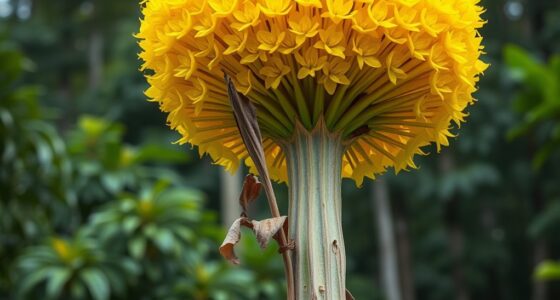
You’ll notice some plants grow rosettes instead of tall stems because this shape helps them conserve energy and survive harsh conditions. By staying low, they reduce wind and weather damage, while their wide root systems efficiently gather limited water and nutrients from tough soils. Flowering close to the ground also protects flowers from herbivores and harsh elements. If you want to discover more about this fascinating plant adaptation, keep exploring further.

Get the little things that make your day delivered free — and shop member deals
- Fast, free delivery on millions of items
- Access to Prime Big Deal Days deals on October 6–7
- Prime Video, Amazon Music and more included
Key Takeaways
- Rosettes reduce exposure to harsh weather, protecting plants from wind, drought, and physical damage.
- Growing low minimizes water loss and conserves resources in nutrient-poor or rocky environments.
- The compact shape offers better stability and anchorage in challenging terrains with strong winds.
- Microclimate near the ground enhances pollination success and reproductive efficiency.
- Shallow root systems spread widely to maximize water and nutrient absorption in sparse soils.

Many plants grow in rosette formations, a distinctive arrangement where leaves radiate outward from a central point close to the ground. This unique shape isn’t just about appearance; it offers specific advantages that influence how these plants survive and reproduce. You might notice that rosette plants often thrive in harsh environments, and their structure plays a key role in their resilience. Their root adaptations are essential here, often spreading out widely or forming dense mats beneath the soil. These extensive root systems help them efficiently gather water and nutrients from the soil, especially in conditions where resources are scarce or sporadically available. The low-growing habit reduces exposure to wind and extreme weather, minimizing water loss and physical damage, which is crucial when conditions are unpredictable.
Their root systems also anchor the plant firmly, preventing toppling in strong winds or heavy rains. Because the plant stays close to the ground, its roots don’t need to reach deep into the soil; instead, they spread out laterally to maximize resource absorption. This adaptation is especially beneficial in rocky or nutrient-poor soils, where deep roots might struggle to find sustenance. Additionally, many rosette plants have developed specialized flowering strategies that enhance their chances of successful reproduction. Instead of shooting tall stems with flowers high above the ground, they often produce flowers close to the ground or even at the base of the rosette. This approach reduces their visibility to herbivores and takes advantage of the microclimate near the soil surface, which can be warmer and more humid, aiding in pollination.
A compact growth form allows these plants to conserve energy during flowering, especially in environments where resources are limited. Some plants with rosette growth forms also use their strategy to conserve energy during flowering. Instead of investing in tall, costly stems, they focus their resources on producing striking flowers at ground level, sometimes in dense clusters that attract pollinators efficiently. This method ensures they can reproduce even in tough environments where tall growth might be risky or impossible. Their flowering strategies, combined with their root adaptations, make them well-suited to survive in challenging habitats. Overall, the rosette form isn’t just a matter of style; it’s a carefully evolved response that maximizes resource use, protects against environmental stresses, and optimizes reproductive success. By staying low and spreading roots widely, these plants turn their compact shape into a powerful survival tool. Additionally, the high contrast ratio of their flower colors can attract specific pollinators, further increasing reproductive success. Understanding these adaptations reveals how plant morphology plays a crucial role in thriving amid adverse conditions.
As an affiliate, we earn on qualifying purchases.
Frequently Asked Questions
Do Rosette Plants Require Different Soil Types Than Tall-Stemmed Plants?
Rosette plants generally don’t require different soil types than tall-stemmed plants, but their success depends on soil pH and nutrient requirements. You should guarantee the soil offers proper pH levels—often slightly acidic to neutral—and supplies essential nutrients like nitrogen, phosphorus, and potassium. Adjusting these factors can help rosette plants thrive, just like tall-stemmed varieties, by providing ideal conditions for healthy growth and development.
How Do Environmental Factors Influence Rosette Versus Tall Stem Growth?
About 60% of plants adapt their growth forms in response to environmental factors. Climate influences determine whether a plant develops a rosette or tall stems, as genetic adaptation helps optimize survival. In colder, windy, or drought-prone areas, plants often grow low and compact to reduce water loss and withstand harsh conditions. Conversely, in lush, stable environments, taller growth can improve light capture and reproductive success.
Are Rosette Plants More Resistant to Certain Pests or Diseases?
Rosette plants often show more pest resistance thanks to their compact structure, making it harder for pests to access essential parts. They also tend to be less susceptible to certain diseases because their low-growing form reduces moisture buildup, which can foster pathogens. However, they might still be vulnerable to specific pests or diseases targeting their base or leaves. Overall, their form provides some natural defenses, but it’s not foolproof.
Can Rosette Growth Be Encouraged in Normally Tall-Stemmed Plants?
Imagine shaping a tree’s silhouette—yes, you can encourage rosette growth in tall-stemmed plants through specific horticultural techniques. By manipulating environmental factors like light, pruning, and nutrient levels, you influence their genetic traits to favor a rosette form. Consistent care and targeted practices can push the plant’s natural tendencies, transforming its architecture from lofty to compact, and highlighting a lush, low-growing rosette display.
Do Rosette Plants Produce Fewer Flowers Than Tall-Stemmed Varieties?
Rosette plants often produce fewer flowers than tall-stemmed varieties because their growth strategy emphasizes compactness and resource conservation, which can limit flower diversity. This structure influences pollination strategies, making them rely on close-range pollinators rather than attracting distant ones. While they may have fewer flowers, their dense arrangement can still effectively attract pollinators, supporting reproductive success in specific environments.
drought tolerant succulent plants
As an affiliate, we earn on qualifying purchases.
As an affiliate, we earn on qualifying purchases.
Conclusion
As you observe these plants, imagine their leaves forming a cozy, protective circle at the ground’s edge, like a lush, green collar. Their rosette shape keeps them close to the soil, shielding them from harsh winds and conserving moisture. This low-growing form creates a vibrant, textured carpet, thriving quietly in their environment. So, next time you see a rosette, picture it as nature’s clever way of hugging the earth, standing resilient and steadfast.
As an affiliate, we earn on qualifying purchases.
As an affiliate, we earn on qualifying purchases.
Halloween Picks
halloween
As an affiliate, we earn on qualifying purchases.