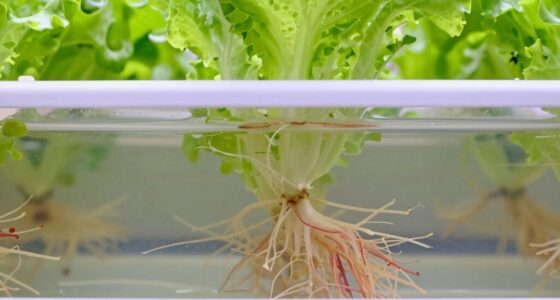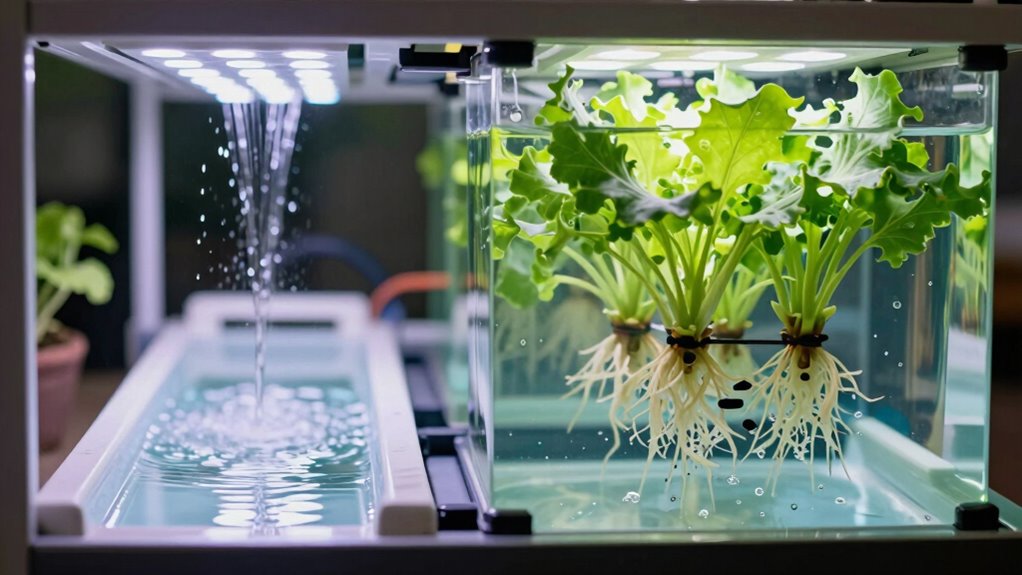

Nutrient Film Technique (NFT) and Deep Water Culture (DWC) differ mainly in design and how they deliver nutrients to your plants. In NFT, a thin stream of nutrient-rich water flows over roots, providing quick nutrient uptake and high oxygen levels thanks to exposed roots. DWC submerges roots in a large water reservoir, relying on oxygenation tools like air stones. Both systems need maintenance, but each has unique advantages and challenges. Exploring more details will help you choose the best setup for your garden.

Get the little things that make your day delivered free with Prime
- Fast, free delivery on millions of items
- Prime Video, Amazon Music and more included
- Member-only deals all year
Key Takeaways
- NFT uses a thin, continuous water film, while DWC suspends roots in a large nutrient-rich water reservoir.
- NFT provides rapid nutrient uptake and high oxygenation through a shallow flow; DWC offers steady nutrients with submerged roots.
- NFT requires consistent water flow; DWC depends on oxygenation via air stones or diffusers.
- NFT is more sensitive to pump failures; DWC is more forgiving but needs careful oxygen level management.
- NFT is ideal for quick nutrient delivery; DWC supports larger plants and higher yields with stable water supply.

When choosing a hydroponic system, understanding the differences between Nutrient Film Technique (NFT) and Deep Water Culture (DWC) is vital for success. Both methods optimize plant growth by delivering nutrients directly to roots, but they do so in distinct ways that impact hydroponic efficiency and root oxygenation. Knowing these differences helps you select the right system for your goals and conditions.
NFT involves a thin, continuous flow of nutrient-rich water passing over the roots, which are supported in a sloped channel or tube. This setup guarantees a steady supply of nutrients, making it highly efficient in terms of water and nutrient use. Since the water flows constantly, you can precisely control nutrient delivery and minimize waste. However, because the water film is thin, the roots are exposed to the air and get plenty of oxygen, enhancing root oxygenation. The thin film also facilitates quick nutrient uptake, which can lead to faster growth. But, NFT systems require a consistent flow, so any pump failure or interruption can quickly dry out the roots, stressing or damaging your plants.
In contrast, DWC suspends the plant roots directly in a deep tank filled with nutrient-rich, oxygenated water. This setup creates a large reservoir of nutrients, making DWC particularly hydroponic efficient for larger plants or higher yields since roots have constant access to nutrients without the need for a continuous flow. Root oxygenation in DWC depends on the dissolved oxygen levels in the water, which you can enhance with air stones or diffusers. Proper oxygenation is essential here because stagnant or poorly oxygenated water can lead to root rot and other issues. As a result, maintaining high dissolved oxygen levels is key to healthy root growth. Additionally, the choice between systems often depends on their maintenance requirements and your ability to monitor and adjust conditions regularly.
While DWC offers simplicity and the potential for high hydroponic efficiency, it demands careful oxygen management. NFT, on the other hand, provides excellent root oxygenation due to the thin water film and exposure to air, but it’s less forgiving of system failures. Both systems have their advantages and challenges, but your choice hinges on your ability to maintain consistent water flow or oxygen levels. If you prefer a system with quick nutrient delivery and excellent oxygenation, NFT might suit you best. If you want a setup that supports larger plants with a steady nutrient supply, DWC could be the better fit. Ultimately, understanding these core differences helps you optimize plant health and maximize your hydroponic success.
As an affiliate, we earn on qualifying purchases.
Frequently Asked Questions
Which System Is Better for Beginners?
For beginners, DWC is often better because it’s simpler to set up and manage. It offers broad plant compatibility, allowing you to grow various crops easily. Plus, its system scalability makes it easier to expand your garden as you gain experience. Nutrient Film Technique systems can be more complex and require more precise control, which might be overwhelming at first. Starting with DWC helps you learn the basics comfortably.
How Do Maintenance Requirements Differ?
You’ll find that nutrient film technique systems require less maintenance overall, mainly because the nutrient solution flows continuously, maintaining stability and reducing the risk of nutrient imbalances. DWC systems, on the other hand, need regular checks of nutrient levels and oxygenation, as roots can suffer from low oxygen if not monitored. With NFT, root oxygenation is naturally improved through constant flow, making it easier to keep nutrients stable and healthy.
Can Both Systems Grow All Plant Types?
Think of your hydroponic setup as a versatile toolbox—you can grow many types of plants, but not all. Nutrient Film Technique (NFT) and Deep Water Culture (DWC) are compatible with a wide range of plants, yet some, like large fruiting crops or root vegetables, may not thrive equally. Your choice depends on plant diversity and system compatibility, ensuring each plant gets the right environment for healthy growth.
What Are the Cost Differences Initially?
You’ll find that initial costs for nutrient film technique (NFT) systems are generally lower than deep water culture (DWC) setups. NFT requires less water and fewer materials, reducing installation expenses. However, you should consider ongoing nutrient costs, as NFT systems often need more frequent nutrient adjustments. DWC setups might involve higher upfront investment due to larger tanks and pumps, but can be more cost-effective long-term for certain crops.
Which System Conserves More Water?
Think of your garden as a delicate dance, where water efficiency takes the spotlight. Nutrient Film Technique (NFT) systems conserve more water than DWC by recycling a thin film of nutrient-rich water, minimizing waste. This approach offers significant sustainability benefits, making your setup more eco-friendly. You’ll use less water overall, reduce runoff, and promote a healthier environment, turning your gardening routine into a harmonious act of conservation.
DWC deep water culture grow system
As an affiliate, we earn on qualifying purchases.
As an affiliate, we earn on qualifying purchases.
Conclusion
So, now you see it—Nutrient Film Technique and DWC are like night and day, each with their own wild, unique magic. One’s a thin, fast-moving river of nutrients, while the other’s a deep, lush oasis of roots basking in constant water. Choose your adventure wisely, because mastering these systems isn’t just gardening—it’s transforming your space into a lush, unstoppable jungle where plants thrive like never before!
hydroponic nutrient film technique setup
As an affiliate, we earn on qualifying purchases.
As an affiliate, we earn on qualifying purchases.
As an affiliate, we earn on qualifying purchases.
Halloween Picks
halloween
As an affiliate, we earn on qualifying purchases.