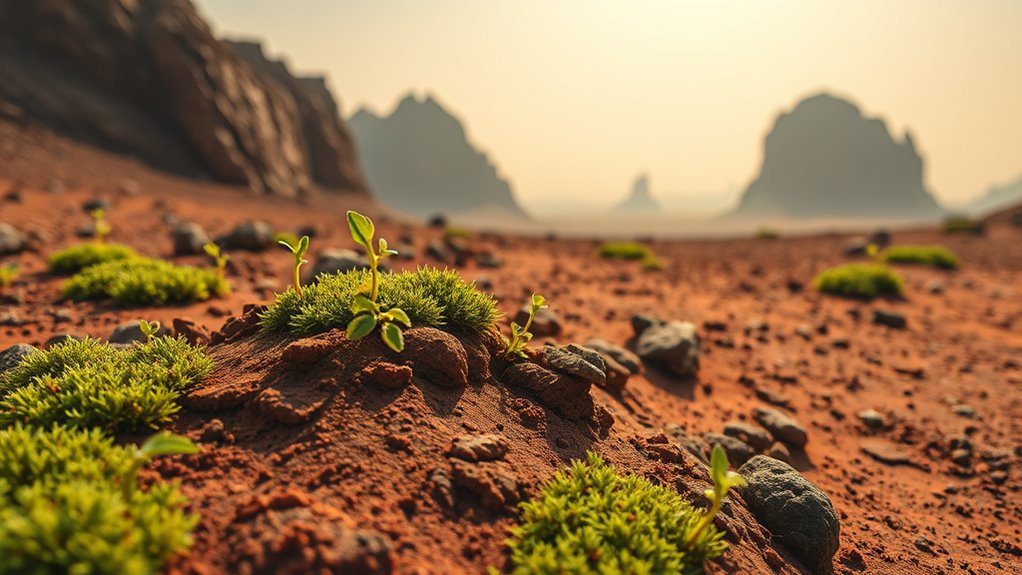

Growing plants in Martian soil is still a big challenge because of its toxicity, lack of nutrients, and extreme environment. Researchers are exploring ways to neutralize harmful chemicals like perchlorates, add nutrients, and modify plants themselves for better survival. Experiments on Earth with simulated Martian soil show promise, but large-scale solutions are complex and costly. Curious about how scientists plan to overcome these hurdles? Keep exploring to uncover the exciting progress toward extraterrestrial agriculture.
Key Takeaways
- Martian soil contains toxic perchlorates, requiring removal or neutralization before supporting plant growth.
- Soil transformation involves adding nutrients and may include microorganisms to make it more suitable for plants.
- Controlled experiments simulate Martian conditions to test plant survival and adaptation in extraterrestrial soils.
- Advances suggest some hardy plants could potentially grow in modified Martian soil with proper amendments.
- Achieving sustainable plant growth on Mars is essential for future colonization and reducing dependence on Earth supplies.
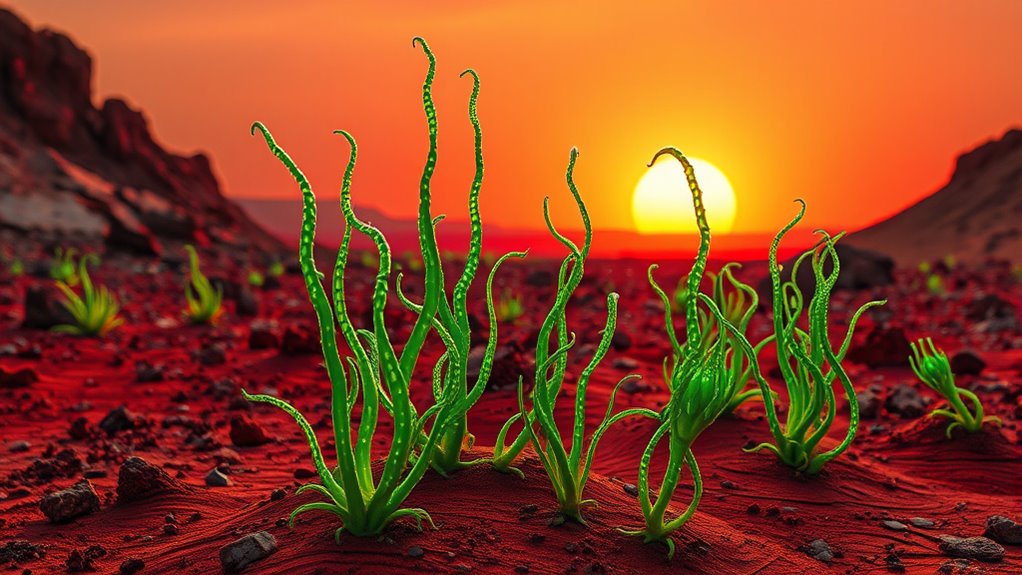
Have you ever wondered if planets beyond our solar system could host life? Exploring this idea leads to a fascinating question: can plants grow in alien soils, like those found on Mars? The answer isn’t straightforward. Scientists face significant terraforming challenges when considering turning Martian land into a habitat suitable for Earth-like life. These challenges include the planet’s thin atmosphere, extreme temperatures, and the chemical composition of its soil. Martian soil, or regolith, contains toxic substances like perchlorates, which would need to be removed or neutralized before plants could thrive. Without addressing these issues, extraterrestrial agriculture remains a distant dream. Ensuring soil safety is a critical step in making Martian soil viable for plant growth.
Terraforming Mars involves more than just making the environment livable for humans; it also requires transforming the soil itself. This process is complex and costly. You’d need to add nutrients, remove harmful chemicals, and perhaps even introduce microorganisms that can help break down the soil’s harsh components. The goal is to create a substrate that can support plant life, but the enormous scale of such efforts makes it a formidable challenge. You’d also have to figure out how to supply sufficient water and maintain stable temperatures, which are critical for plant growth. All these factors contribute to the terraforming challenges that scientists are still trying to solve.
Despite the hurdles, researchers are actively experimenting with extraterrestrial agriculture. They’re trying to grow plants in simulated Martian soil on Earth, using controlled environments that mimic the planet’s conditions. These experiments help identify which plants might adapt best to alien soils and what soil amendments are necessary to support growth. Some hardy plants, like certain grasses and lichens, have shown promise in surviving harsh conditions. Scientists also explore genetically modifying crops to withstand the stresses of extraterrestrial environments. The hope is that, someday, humans could cultivate food on Mars, reducing the need to bring all supplies from Earth.
While the idea of growing plants on Mars is still in its infancy, progress is encouraging. Each experiment brings us closer to understanding what it takes to overcome terraforming challenges and make extraterrestrial agriculture feasible. The prospect of cultivating life beyond Earth isn’t just about growing food; it’s about establishing sustainable colonies that can support human life long-term. For now, growing plants in Martian soil remains a bold scientific goal, but with continued research and innovation, it might not be just a science fiction fantasy for much longer.

MySoil Soil Test Kit, Unlock Your Lawn & Garden Potential, Complete & Accurate Nutrient and pH Analysis with Recommendations Tailored to Your Soil and Plant Needs
- Professional Soil Testing Kit: Accurately measures nutrients and pH
- Fast Results: Receive analysis in 6-8 days
- Versatile Compatibility: Suitable for all soil types and plants
As an affiliate, we earn on qualifying purchases.
As an affiliate, we earn on qualifying purchases.
Frequently Asked Questions
What Nutrients Are Essential for Plant Growth on Mars?
You need to provide essential soil nutrients for plant growth on Mars, including nitrogen, phosphorus, potassium, and trace minerals like magnesium and calcium. These plant requirements support healthy development, root growth, and photosynthesis. Since Martian soil lacks many of these nutrients naturally, you must supplement or modify the soil to make certain your plants get what they need. Properly balanced soil nutrients are vital for sustainable agriculture on the Red Planet.
How Does Martian Soil Differ Chemically From Earth Soil?
You’ll notice that Martian soil differs chemically from Earth’s mainly in soil mineralogy and pH level differences. Mars soil contains more perchlorates and fewer organic compounds, making it less hospitable for plants. Its mineralogy includes iron oxides giving it a reddish color, while Earth’s soil has diverse minerals and organic matter. The pH level on Mars tends to be more alkaline, which can affect nutrient availability and plant growth.
Can Genetically Modified Plants Survive in Martian Conditions?
Like explorers venturing into uncharted worlds, you can develop genetically modified plants to survive Mars’s harsh environment. Genetic modification enhances plant resilience, making them better equipped for extreme conditions like low temperatures, radiation, and limited nutrients. While challenges remain, advances in biotech suggest you could cultivate resilient crops that thrive on Mars, turning barren landscapes into sustainable habitats for future colonists.
What Role Does Water Availability Play in Martian Agriculture?
Water availability is vital for Martian agriculture because it directly affects soil moisture and water retention. Without sufficient water, plants can’t absorb nutrients or grow properly. You need to optimize water retention in the soil, perhaps through innovative techniques like adding moisture-retaining compounds or using controlled irrigation. Ensuring adequate soil moisture helps plants thrive, making water availability a key factor in successful farming on Mars.
Are There Any Existing Experiments Growing Plants on Mars?
Yes, scientists are conducting experiments growing plants on Mars, focusing on soil sterilization and plant adaptation. You can imagine how they sterilize Martian soil to remove harmful microbes, then introduce specially selected or genetically adapted plants that can survive in harsh conditions. These experiments help determine if future colonists can cultivate food on Mars, making space agriculture a promising step toward sustainable extraterrestrial living.

Espoma Soil Perfector Permanently Improves All Soils. A Simple One Time Application Prevents Compaction and Promotes Plant Root Growth. 30 lb. Bag ~ Pack of One
- Contains durable volcanic granules: Made from kiln-fired ceramic mineral
- Suitable for various plants: Use for flowers, vegetables, trees, shrubs, potted plants
- Enhances soil quality: Improves drainage, moisture retention, and soil structure
As an affiliate, we earn on qualifying purchases.
As an affiliate, we earn on qualifying purchases.
Conclusion
So, imagine planting your favorite Earth seeds on Mars and watching a tiny green sprout burst through the red dust—transforming the barren wasteland into a lush, vibrant paradise. It’s almost like planting a forest on the moon! While it sounds like science fiction, breakthroughs could make Martian gardens a reality someday. Who knows? Maybe one day, you’ll sip coffee grown in alien soil, proving that even the harshest worlds can bloom with a little hope and science.

Epic Gardening Seed Starting Grow Light – Full-Spectrum LED with Adjustable Height & Integrated Tray for Indoor Seedlings | Energy-Efficient, Long-Lasting Light with Timer (Standard)
- Full-Spectrum LED for Growth: Provides ideal light spectrum for seedlings
- Integrated Watertight Tray: Holds multiple seed trays, keeps area clean
- Energy-Efficient & Long-Lasting: Uses 40W, lasts up to 25,000 hours
As an affiliate, we earn on qualifying purchases.
As an affiliate, we earn on qualifying purchases.

EM•1® Microbial Inoculant – Original Effective Microorganisms® – Soil Amendment for Agriculture & Gardening
- Abbreviation: EM stands for Effective Microorganisms
- Supports Soil Biology: Promotes balanced soil and microbial activity
- Suitable Uses: Ideal for farms, gardens, and landscaping
As an affiliate, we earn on qualifying purchases.
As an affiliate, we earn on qualifying purchases.