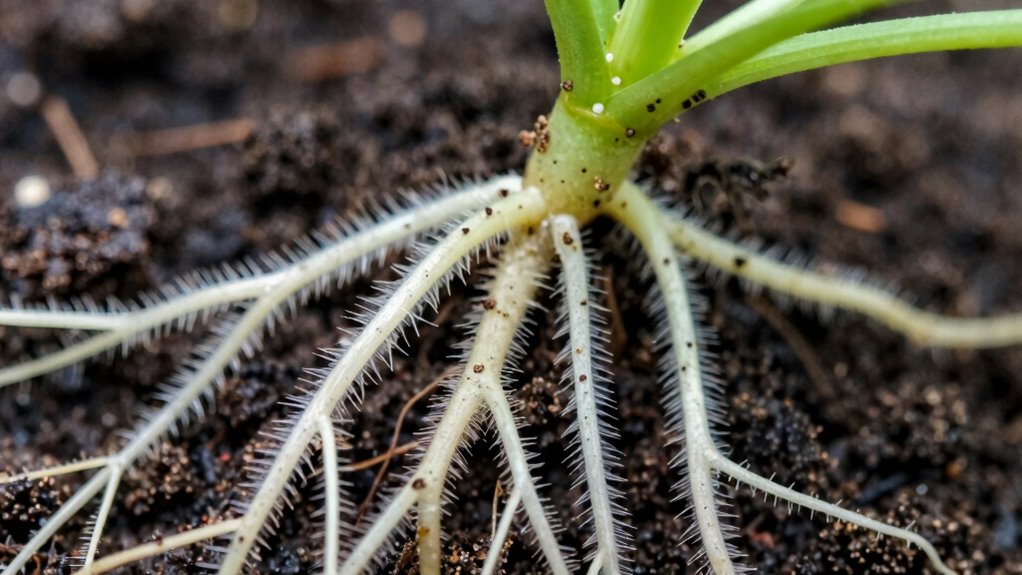

Root hairs help your plants feed efficiently by increasing the surface area for soil contact, allowing them to absorb more water and nutrients like nitrogen, phosphorus, and potassium. These tiny extensions penetrate tiny soil spaces, accessing nutrients bound to soil particles that larger roots can’t reach. They also adapt to moisture changes, ensuring steady nutrient uptake even during drought. To discover how soil management can boost root hair growth, keep exploring further.
Key Takeaways
- Root hairs increase soil contact area, enhancing nutrient and water absorption.
- They penetrate tiny soil spaces, accessing nutrients unavailable to main roots.
- Root hairs absorb nutrients tightly bound to soil particles, improving nutrient uptake.
- They adapt to moisture fluctuations, maintaining nutrient absorption during droughts.
- Healthy root hairs result from optimal soil conditions, boosting plant feeding efficiency.

Root hairs play a essential role in helping plants absorb nutrients and water from the soil. These tiny extensions sprout from your plant’s roots, dramatically increasing the surface area available for soil contact. This expanded surface allows you to access more nutrients and moisture, which are fundamental for your plant’s growth and health. Without root hairs, your plant’s ability to efficiently take in necessary nutrients would be severely limited, especially in nutrient-poor soils. As your roots develop, so do the root hairs, and this process is key for enhancing soil nutrient absorption. The better your root hairs develop, the more nutrients—like nitrogen, phosphorus, and potassium—your plant can extract from the soil. This makes root hair development a main factor in the overall health and vigor of your plant.
When your plant’s root hairs grow, they penetrate deeper into the soil and reach tiny spaces that larger roots can’t access. These microscopic hairs act like tiny sponges, soaking up water and dissolved nutrients. Because they are so small, they can access nutrients that are tightly bound to soil particles, which larger roots might miss. This close contact with the soil environment enhances your plant’s ability to absorb nutrients efficiently. As soil moisture levels fluctuate, root hairs adapt by elongating or proliferating, ensuring your plant continues to absorb what it needs, even under less-than-ideal conditions. This dynamic growth of root hairs is essential for maintaining a consistent supply of nutrients, especially during periods of stress or drought. Additionally, soil conditions play a critical role in influencing root hair growth and overall plant health. Improving soil management practices can promote healthier root hair development and boost your plant’s nutrient uptake.
Research indicates that plant nutrient uptake is significantly impacted by root hair development, emphasizing the importance of healthy soil management. The development of root hairs isn’t just about increasing surface area; it also involves a complex process of cellular growth and differentiation. This process is sensitive to soil conditions, such as pH, moisture, and nutrient availability. When conditions are favorable, root hairs thrive, boosting soil nutrient absorption. Conversely, if the soil is too acidic or deficient in nutrients, root hair growth slows down, limiting your plant’s ability to feed itself effectively. That’s why maintaining healthy soil conditions is necessary for encouraging vigorous root hair development. Proper soil management, including adequate fertilization and watering, supports the formation of a dense network of root hairs, ensuring your plant can maximize nutrient uptake. Additionally, research shows that color accuracy in soil and plant health monitoring can help optimize conditions for root hair growth, leading to healthier plants.

AROMATICA Root Enhancer Rosemary water spray for hair growth – with rosemary oil & caffeine & biotin – Korean hair care for hair thinning & hair loss – free from silicone, paraben and sulfate
ROSEMARY WATER & ROSEMARY OIL FOR HAIR GROWTH: Feel the difference after using our Rosemary Root Enhancer. If…
As an affiliate, we earn on qualifying purchases.
As an affiliate, we earn on qualifying purchases.
Frequently Asked Questions
How Do Root Hairs Develop During Plant Growth?
You’ll notice root hairs develop as an extension of root epidermal cells during plant growth. Root hair formation begins when specific cells in the root epidermis differentiate into hair-forming cells called trichoblasts. These cells then grow into slender, hair-like structures. The main function of root hairs is to increase surface area, allowing the plant to absorb more water and nutrients efficiently from the soil, supporting healthy growth and development.
Can Root Hairs Regenerate After Damage?
Yes, root hairs can regenerate after damage, thanks to their resilience. If damage occurs, the plant activates damage repair mechanisms, allowing new root hairs to develop from existing root tissues. This resilience guarantees the plant maintains efficient nutrient and water absorption. You’ll notice that healthy root systems adapt quickly, restoring their capacity to support plant growth despite injuries, highlighting the importance of root hair resilience and damage repair for plant health.
Do All Plants Have Root Hairs?
Not all plants have root hairs, especially some aquatic or specialized plants. Root hair types vary, but their main function remains consistent: increasing surface area for water and nutrient absorption. You can imagine tiny hair-like extensions on roots, which help you see how they efficiently gather essential resources from the soil. These root hair functions are crucial for most terrestrial plants, supporting healthy growth and nutrient uptake.
How Do Root Hairs Affect Nutrient Absorption Speed?
Root hairs greatly boost nutrient uptake mechanisms by increasing the surface area of your roots. The higher the root hair density impact, the faster nutrients like water, minerals, and essential ions are absorbed from the soil. This efficiency allows your plant to access nutrients more quickly, supporting healthy growth. So, by developing numerous root hairs, your plant can optimize nutrient absorption, especially in nutrient-poor soils, ensuring better overall health.
Are Root Hairs Affected by Soil pH Levels?
Soil pH impact does influence root hairs, and soil acidity can cause root hairs to diminish or malfunction. When soil becomes too acidic or alkaline, it hampers root hair health, reducing nutrient absorption. You’ll notice that in extreme pH levels, your plant’s roots struggle to thrive because soil conditions disrupt their delicate structure. So, maintaining proper soil pH is essential for healthy root hairs and ideal plant nourishment.

Rapitest Soil Test Kit for Gardens, Vegetables, Flowers and Lawns. USA designed and assembled soil tester completely, quickly and accurately measures/analyzes soil pH acidity and garden nutrients.
Quick, at home results for Soil pH, Nitrogen, Phosphorous and Potash Innovative and inexpensive soil test kit features…
As an affiliate, we earn on qualifying purchases.
As an affiliate, we earn on qualifying purchases.
Conclusion
Understanding how root hairs boost plant feeding shows just how essential they are. Did you know that root hairs increase a plant’s surface area by up to 20 times? This means they can absorb more water and nutrients efficiently, helping your plants grow strong and healthy. Next time you see a plant thriving, remember those tiny root hairs working tirelessly beneath the surface—making sure your plant gets everything it needs to flourish.

Nature's Wonder Organic Soil Conditioner & Root Booster for Plants – Concentrated Liquid Biostimulant with Fulvic Humic Acid for Plants, Potting Soil, Flowers & Lawns – 60oz
THE ULTIMATE SOIL & PLANT HEALTH TECHNOLOGY: Tested & proven to- Boost the benefits of your plant food…
As an affiliate, we earn on qualifying purchases.
As an affiliate, we earn on qualifying purchases.

Stainless Steel Deep Root Tree Watering Tool,Root Feeder with Fertilizer Bottle Watering Wand Irrigation System Watering Stake,for Trees Bushes Shrubs Fruit Trees with Brass Valve T-Handle
【Unique Design Deep Root Tree Watering Tool】 Our root watering tool have four exit hole for the water,won't…
As an affiliate, we earn on qualifying purchases.
As an affiliate, we earn on qualifying purchases.