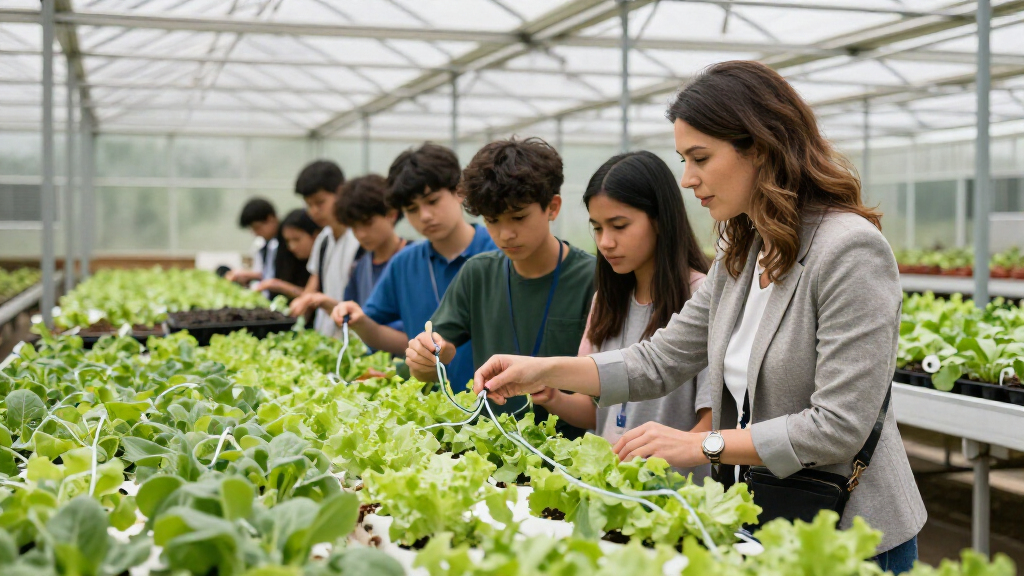
TL;DR
A workforce-development proposal argues that community colleges can help address controlled environment agriculture’s need for technicians who understand both crop production and greenhouse technology. The approach would pair hands-on college training with employer input and access to commercial equipment, but the source provides no evidence of a new program or confirmed industry commitments.
A workforce-development report is urging controlled environment agriculture (CEA) employers to work with community colleges to prepare greenhouse technicians who can handle both crop production and increasingly technical systems. The proposal identifies a gap between university education and on-the-job training, while citing federal labor projections and 2026 USDA grants as evidence of interest in agricultural technician training.

Get the little things that make your day delivered free with Prime
- Fast, free delivery on millions of items
- Prime Video, Amazon Music and more included
- Member-only deals all year
The report describes a “missing middle” in CEA workforce preparation: many greenhouse jobs do not require a four-year degree, but complex production systems may demand more structured preparation than employers can provide through informal training alone. Technicians may need skills in plant physiology, irrigation and fertigation, environmental controls, sensors, lighting, hydroponics and automated equipment.
The U.S. Bureau of Labor Statistics projects employment of agricultural and food science technicians to grow 5% from 2025 to 2035, compared with about 3% for all occupations. It estimates roughly 5,900 openings per year in the occupational group over that decade and lists greenhouses among the places these technicians work. These figures cover a broader occupation, not CEA jobs alone.
The report also cites $3 million in USDA grants awarded in 2026 to six projects through the National Institute of Food and Agriculture’s Agricultural Workforce Training at Community Colleges program. The program emphasizes experiential, job-based learning, industry-accepted credentials and occupational competencies. The source does not say that any of those grants specifically fund CEA programs.
Grow greenhouse skills through college–industry partnerships
A proposal calls for community colleges and employers to prepare technicians who can manage both crops and greenhouse systems. It describes a training opportunity, not a confirmed program.
Why the training gap matters
Greenhouse roles may need more preparation than informal workplace training alone can provide.
Understand plant production
Training could cover crop scouting, plant physiology, sanitation and crop management.
Operate greenhouse technology
Technicians may work with irrigation, fertigation, sensors, lighting and environmental controls.
Build training with employers
The proposal connects college instruction with practical experience and industry input.
Growers and educators identify competencies expected of entry-level hires.
Students learn through college facilities, commercial equipment or site access.
Suppliers could contribute equipment demonstrations, software access and technical workshops.
What is established—and what is not
The cited figures describe broader agricultural training and employment, not confirmed CEA outcomes.
| Evidence in the report | Still unclear |
|---|---|
| BLS projections cover agricultural and food science technicians overall. | Demand specifically for greenhouse technicians. |
| USDA grants support six community-college agricultural training projects. | Whether any grant funds a CEA program. |
| The proposal recommends college–industry collaboration. | Committed partners, launch dates or measured results. |
Training Technicians for Modern Greenhouses
CEA facilities depend on people who can monitor crops while operating systems that regulate growing conditions. A shortage of workers prepared for both sides of that work could make recruitment and onboarding more difficult as greenhouse technology grows more sophisticated. The report’s central argument is that hands-on technical training could help employers find candidates with relevant skills without requiring every entry-level worker to hold a bachelor’s degree.
Community colleges already train students for technical occupations through classroom instruction and practical experience. A CEA program could apply that model to skills such as crop scouting, sanitation, irrigation troubleshooting, environmental controls and basic data interpretation. If colleges and employers agree on the competencies, students could practice tasks they are likely to encounter at work, while growers could have a clearer role in shaping entry-level preparation.
The potential benefit remains a proposal, not a measured result in the source material. It supplies no placement, retention or productivity data showing how a college-industry CEA program affects employers or graduates. The case for partnership rests on the skills described, labor projections for a broad occupational group and the existing workforce-education role of community colleges.
Products Worth Considering

Greenworks 40V Brushless Electric Leaf Blower with 4.0 Ah Battery and Charger

Solo Stove Pi Prime Portable Propane Pizza Oven

Husqvarna Automower 435X AWD Robotic Lawn Mower
As an affiliate, we earn on qualifying purchases.
The College-to-Greenhouse Skills Gap
The report’s author writes from experience as an agriculture professor at Collin College in North Texas, where courses include greenhouse crop production, horticulture, agricultural construction and small farming. Students use greenhouse and growing spaces to propagate plants, manage crops, work with nutrient solutions and irrigation, observe environmental conditions and troubleshoot production problems.
The college is also beginning to introduce students to hydroponic production, including Bato bucket systems. The author says these experiences make topics such as substrates, fertigation, crop selection and environmental management more practical. At the same time, the report notes that a teaching greenhouse differs from a commercial facility: colleges may face limited space, infrastructure and budgets, while equipment and employer needs change over time.
For that reason, the author argues that internships should be only one part of employer involvement. Growers could advise on curricula and identify skills expected of new hires. Suppliers could support training through demonstration equipment, software access, guest instruction, faculty training, technical workshops and facility tours. The report does not describe a specific partnership already in operation.
““missing middle””
— The report’s author
Programs and Employer Commitments Unclear
The source presents a workforce-development argument, but it does not announce a new CEA certificate, college-industry partnership or funding commitment. It also does not identify employers that have agreed to participate, colleges planning programs, or a timeline for implementation. The USDA grants cited support community-college agricultural training projects, but the source does not establish that they cover controlled environment agriculture.
It is also unclear which competencies employers would prioritize across different greenhouse operations, how training would be funded, or whether colleges could keep equipment and instruction aligned with fast-changing systems. The BLS projections concern agricultural and food science technicians overall; they do not quantify demand specifically for greenhouse technicians.
The report calls for growers and suppliers to help colleges define entry-level competencies and provide students with opportunities to operate relevant systems. A practical next step would be for employers and educators to identify common skills, then determine what can be taught in college facilities and what requires access to commercial sites or equipment. The source does not give a date or named organization for such a plan.
Any future program would need to show whether students gain skills employers recognize and whether graduates find and remain in relevant jobs. Until colleges or industry partners announce specific programs and results, the proposal remains a workforce-development recommendation rather than a confirmed expansion of CEA training.
Key Questions
What is controlled environment agriculture?
Controlled environment agriculture grows crops in managed environments, including greenhouses. Operations may use systems for irrigation, fertigation, lighting, environmental controls and crop monitoring.
Why does the report focus on community colleges?
The report argues that community colleges can provide career-focused, hands-on training for technical jobs that may not require a four-year degree. It proposes that this could address a gap between university education and informal workplace training.
Does the USDA funding cited support CEA programs?
The source says USDA’s National Institute of Food and Agriculture awarded $3 million to six community-college workforce projects in 2026. It does not say whether any of those projects focus specifically on CEA.
Are new greenhouse technician programs confirmed?
No new program or employer commitment is identified in the source. The report recommends partnerships, but does not provide a launch date, participating employers or confirmed college plans.
Source: greenhousegrower.com